
Link Building for SEO: Process, Benefits, Types, Tools & Reporting
 By Saurav Agarwal
Last updated
By Saurav Agarwal
Last updated
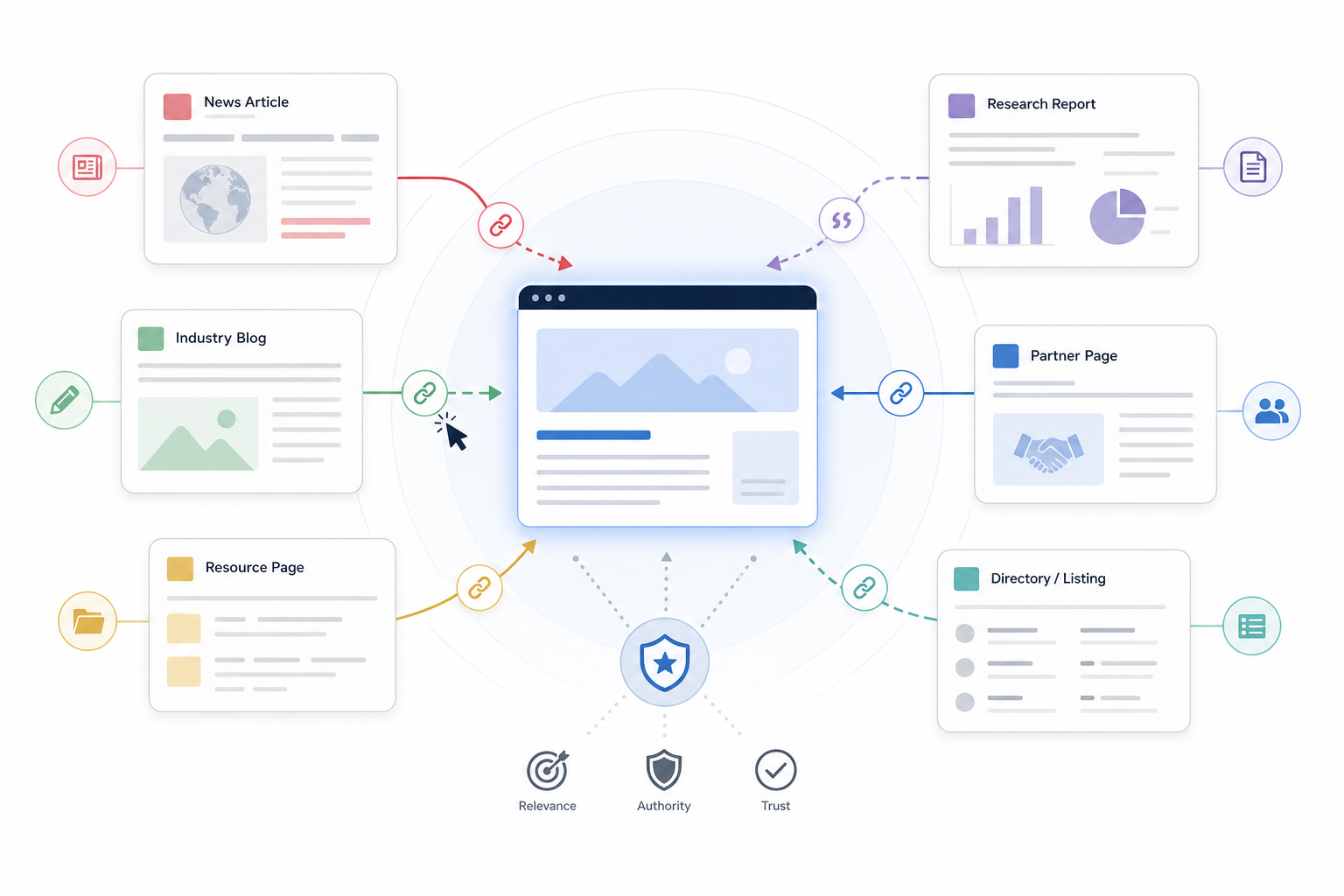
Link building is the SEO practice of earning, acquiring, or developing relevant hyperlinks from external webpages to pages on your own website. These incoming external hyperlinks are called backlinks, and they connect a source webpage with a destination webpage on another website.
Search engines can use links as part of broader systems for discovering webpages and understanding relationships, context, and relative importance across the web. A backlink can also send referral traffic when a user clicks the link and visits the destination directly. Discovery, referral traffic, and ranking support are separate possible effects; finding a page through a link does not guarantee that the page will be crawled, indexed, or ranked.
Modern link building is not simply the accumulation of backlinks. A legitimate link normally exists because the source has a reason to cite, recommend, identify, credit, reference, or provide further information from the destination. That relationship involves attributes such as the source page, destination page, surrounding content, anchor text, audience, editorial purpose, and link attributes such as nofollow, sponsored, or UGC.
Link relevance also extends beyond whether two domains operate in the same broad niche. A page on a large general publication can be highly relevant to a specific product, study, or topic, while a page on an industry-specific website can still be unrelated. Third-party measurements such as Domain Rating, Domain Authority, Authority Score, and Trust Flow can support research, but they are not direct Google ranking metrics.
Link building belongs primarily within off-page SEO because the reference originates outside the target website. It also overlaps with content marketing, digital PR, partnerships, brand marketing, research, product marketing, and audience distribution. Useful link opportunities can come from original research, tools, expert contributions, business relationships, integrations, resource pages, broken-link replacement, and other situations where an external publisher has a genuine reason to reference the destination.
The importance of deliberate link building varies by the query, competition, website maturity, brand recognition, existing backlink profile, page quality, and search opportunity. Some pages can rank without active link acquisition, while others compete in search results where several relevant pages also have substantial external recognition. Link building should therefore begin with a strategic reason for earning external references rather than a fixed backlink quota.
What Is Link Building in Digital Marketing?
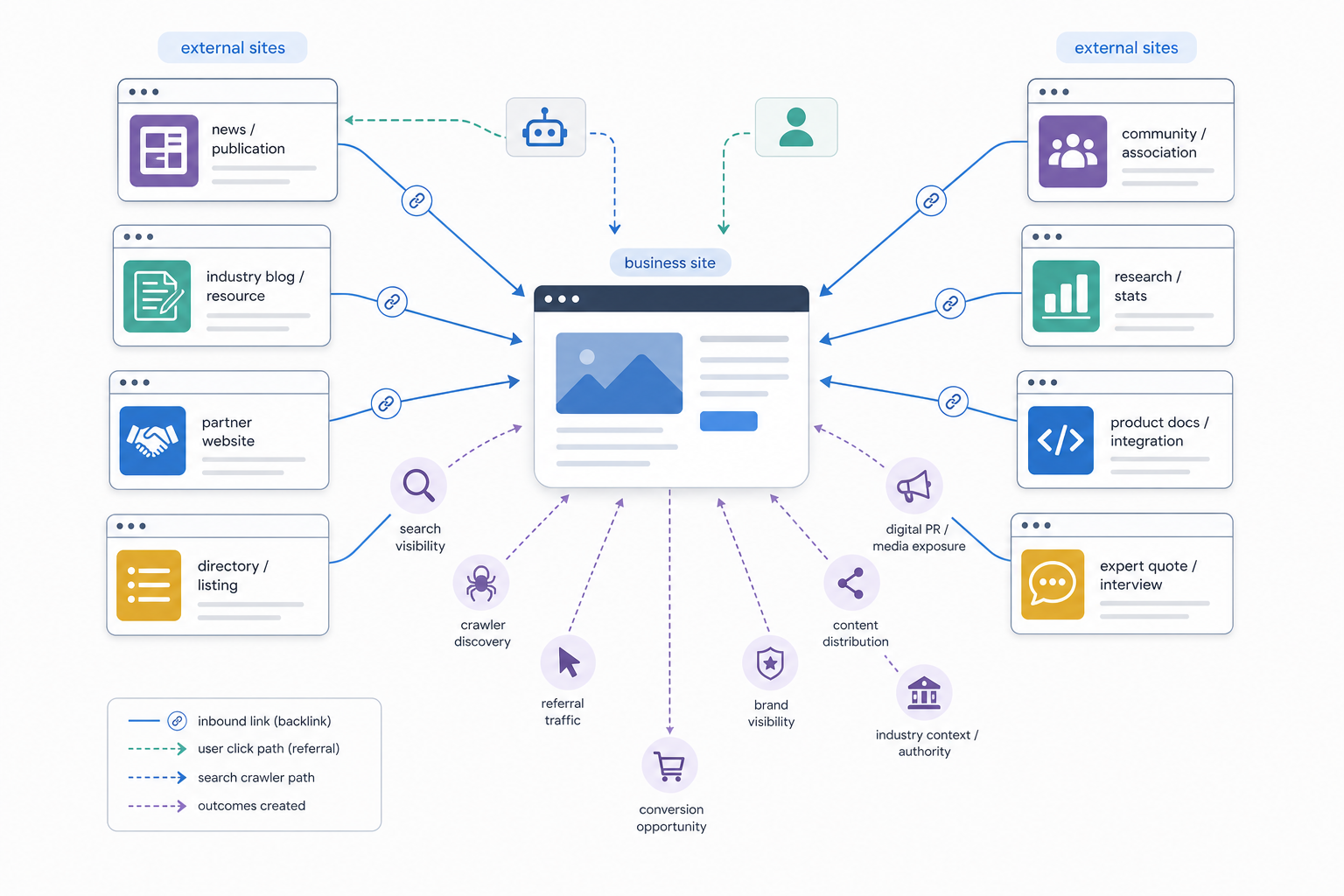
Link building in digital marketing is the process of earning or acquiring relevant hyperlinks from external websites to a business’s own webpages so those references can support search visibility, audience discovery, referral traffic, content distribution, PR, and other marketing outcomes. It extends beyond rankings because the same external reference can serve users, publishers, brands, and search systems in different ways.
- SEO: Relevant backlinks can contribute to the broader signals search engines use to understand relationships and evaluate webpages. They work alongside content quality, search intent, technical accessibility, internal links, and other ranking systems.
- Organic Visibility: External references can support pages competing for relevant searches, but a backlink does not guarantee a ranking increase.
- Page Discovery: Links provide another path through which search-engine crawlers can discover a URL. Discovery does not guarantee crawling, indexing, or ranking.
- Referral Traffic: A user can click a link on an external publication, directory, partner page, resource page, or article and visit the destination directly.
- Audience Discovery: A backlink can expose a product, company, expert, tool, or resource to people who had not previously encountered it.
- Content Marketing: Assets such as original studies, statistics, tools, templates, guides, and datasets can give publishers a reason to cite a company’s content.
- Digital PR: Media stories, research campaigns, expert commentary, interviews, and original data can generate editorial references alongside brand mentions and media exposure.
- Brand Visibility: External references can place a company or product in front of relevant audiences even when users do not immediately click the link.
- Industry Context: A relevant publication can associate a business, expert, product, or resource with a specific subject through a contextual citation.
- Partnership Marketing: Integrations, co-marketing projects, suppliers, distributors, customers, associations, and other genuine business relationships can naturally produce references.
- Research Marketing: Original surveys, benchmarks, studies, statistics, and datasets can attract citations from journalists, researchers, publishers, and industry writers.
- Product Marketing: Product launches, integrations, features, tools, benchmarks, and documentation can create legitimate reasons for external websites to reference a product.
- Expert Marketing: Subject-matter experts can receive citations when journalists or publishers use their commentary, analysis, data, or technical knowledge.
- Community Marketing: Genuine involvement in industry groups, professional communities, open-source projects, local organizations, or associations can result in natural references.
- Conversion Opportunity: Referral visitors can eventually become leads, trial users, subscribers, customers, or buyers when the source audience and destination page are appropriately matched.
Link building is different from content marketing, digital PR, partnership marketing, and referral marketing even though these activities can overlap. Content can provide something worth referencing; PR can create media attention; partnerships can create business relationships; referral programs can incentivize recommendations. Link building specifically concerns the external hyperlink relationships that result from these or other legitimate situations.
How Does Link Building Work?
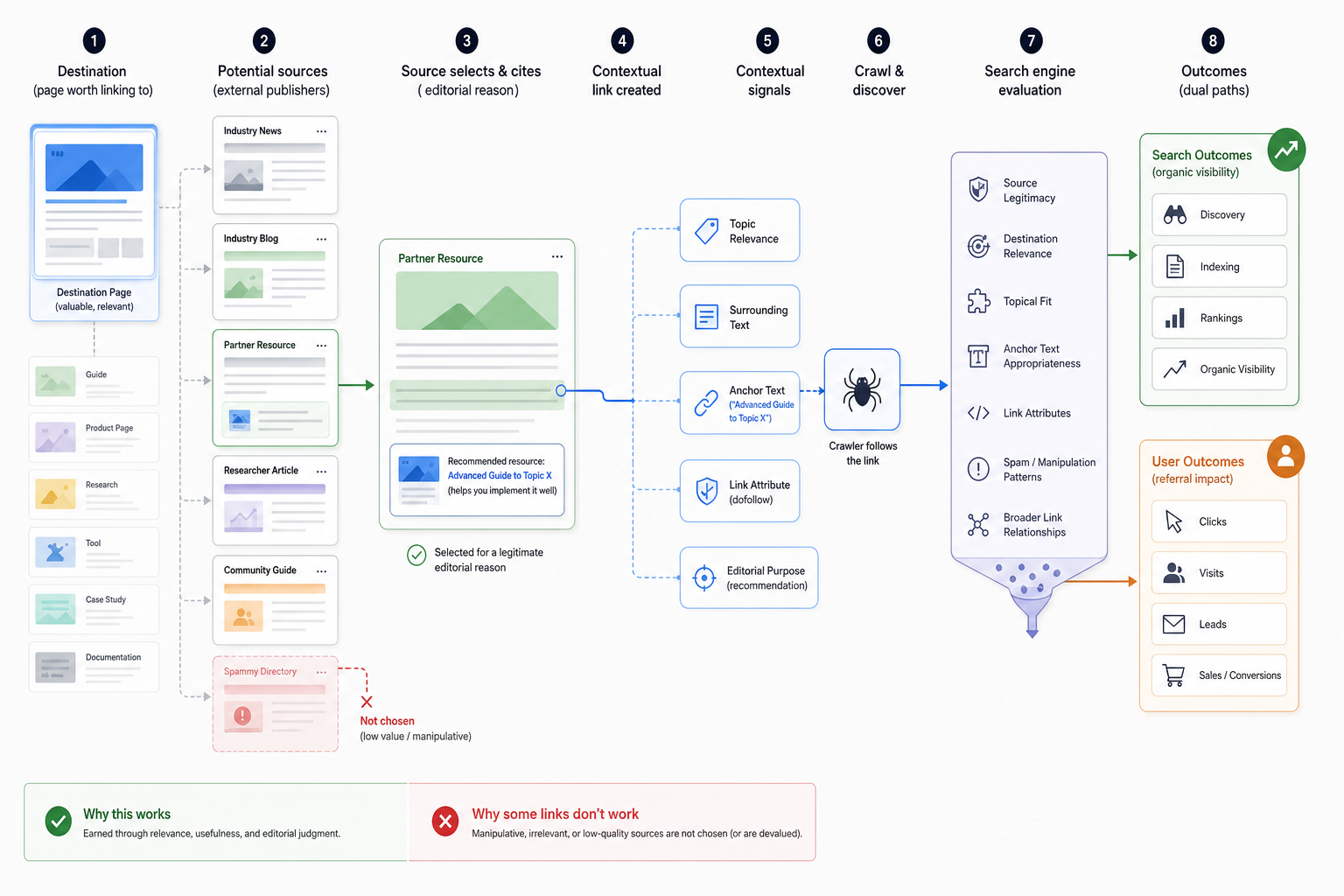
Link building works by creating a legitimate reason for another website to reference a relevant page, after which the hyperlink can be discovered by users and search engines and evaluated within the wider context of the source and destination. A backlink can support search discovery, contextual understanding, organic competitiveness, and referral traffic without guaranteeing any one outcome.
1. A Useful Destination Exists
The destination can be:
- A homepage
- A product page
- A service page
- A category page
- A guide
- Original research
- A tool
- Documentation
- A case study
- A dataset
The page needs a credible reason to be referenced. Not every link campaign requires a dedicated “linkable asset.”
2. An External Publisher Discovers the Destination
A publisher, journalist, researcher, company, creator, partner, or website owner can discover the page through:
- Search
- Outreach
- PR
- Existing relationships
- Communities
- Social distribution
- Industry research
- Independent browsing
Publishing useful content alone does not guarantee external discovery.
3. The Publisher Has a Reason to Reference It
Legitimate reasons include:
- Supporting a factual claim
- Citing original research
- Recommending a tool
- Identifying a product
- Crediting an expert
- Documenting a partnership
- Providing further reading
- Replacing an unavailable resource
The reason for the reference is central to evaluating the resulting backlink. Different link building techniques can create that opportunity through research, PR, partnerships, resource promotion, reclamation, or outreach, but each still needs a credible reason for the external reference.
4. A Hyperlink Is Added
The external page links to the most relevant destination.
A product recommendation can point to a product page, while a research citation can point directly to the study that contains the data.
Forcing every backlink toward the homepage or a commercial page can break the natural relationship between the source and destination.
5. The Backlink Exists Within Context
Search engines and users can observe information around the hyperlink, including:
- Source-page topic
- Surrounding sentence
- Anchor text
- Destination page
- Editorial purpose
- Link attributes
A backlink is therefore more than an isolated connection between two URLs.
6. Anchor Text Adds Context
Anchor text can include:
- Brand names
- URLs
- Page titles
- Product names
- Resource names
- Descriptive phrases
Natural editorial wording is preferable to forcing repetitive exact-match commercial anchors.
7. Crawlers Can Discover the Destination
When a crawler accesses the source page, it can identify the hyperlink and potentially discover the destination URL.
The destination must still be crawled, rendered where necessary, evaluated for indexing, and ranked independently.
8. Search Engines Evaluate the Relationship
Search systems can evaluate factors such as:
- Source page
- Destination page
- Topical context
- Anchor text
- Link attributes
- Editorial legitimacy
- Spam patterns
- Broader link relationships
The exact weight assigned to an individual backlink is not publicly measurable.
9. Source and Destination Relevance Matter
A useful link has a logical relationship between the source and destination.
Relevance can exist through:
- Topic
- Audience
- Product
- Entity
- Industry
- Business relationship
- Geographic context
The entire domain does not need to belong to the same narrow niche.
10. Source Legitimacy Matters
A real publication with genuine content and an editorial reason to link is different from a website created mainly to generate links.
Useful evaluation can consider:
- Editorial quality
- Audience
- Page relevance
- Business purpose
- Linking behavior
- Source history
- Content quality
No single third-party metric can determine legitimacy.
11. Link Attributes Add Information
Common link attributes include:
- nofollow
- sponsored
- ugc
These attributes provide additional information about the relationship. A link should not be considered worthless simply because it is not an ordinary followed editorial link.
12. Users Can Click the Link
A backlink is also a navigation path.
Referral visitors can:
- Read another article
- Register
- Request a demo
- Subscribe
- Contact the business
- Buy a product
Referral value depends on the source audience, placement, context, and destination.
13. Search and Referral Effects Are Measured Separately
Search performance can be evaluated through:
- Impressions
- Rankings
- Organic clicks
- Organic traffic
Referral performance can be evaluated through:
- Referral visits
- Engagement
- Leads
- Trials
- Sales
- Revenue
An acquired backlink is an output. Traffic, rankings, leads, and sales are downstream outcomes.
How Does Link Building Help SEO?
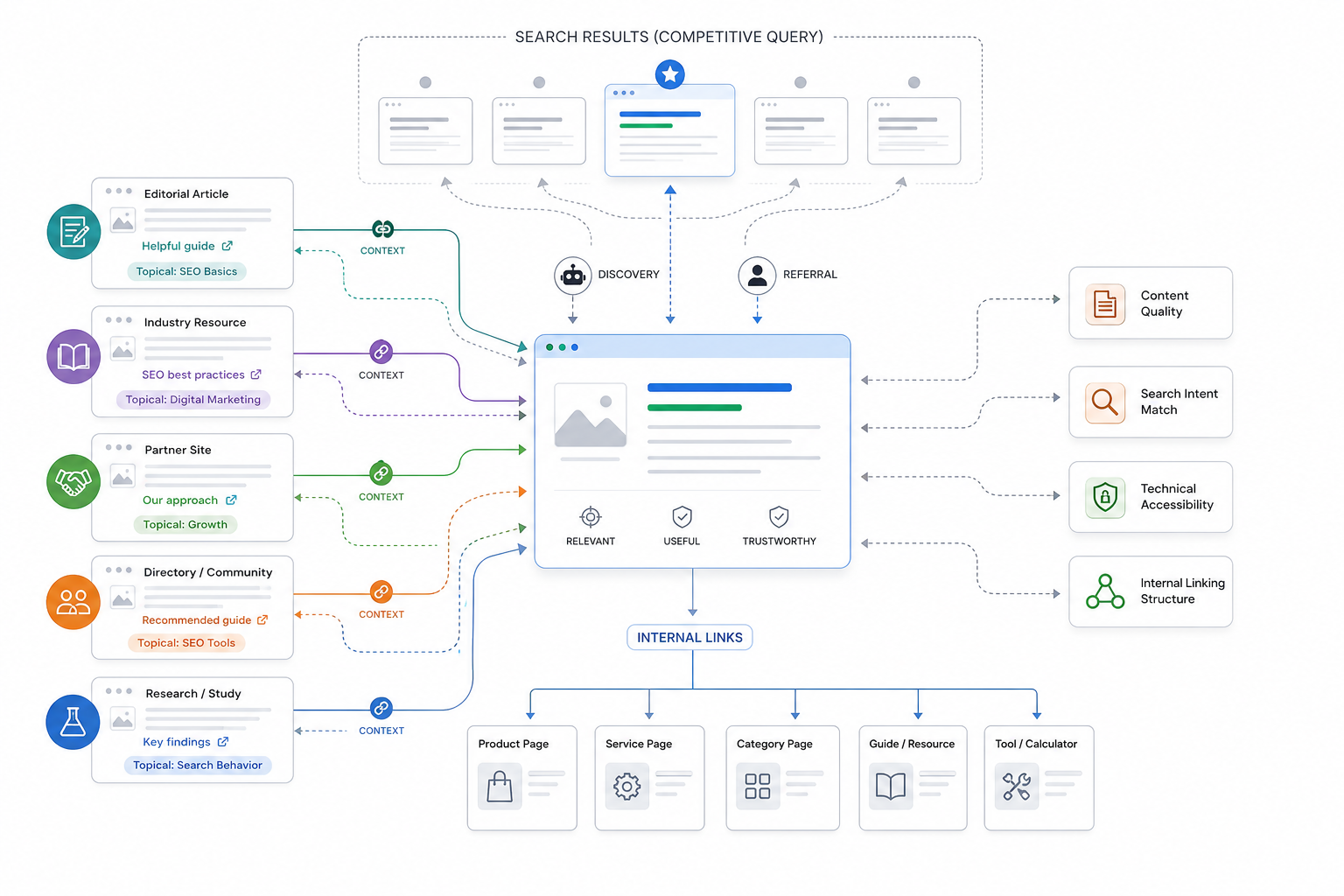
Link building helps SEO by giving search engines external evidence about relationships between webpages while creating additional discovery paths and referral routes to the destination. Relevant backlinks can support search competitiveness, but they work with content quality, search intent, technical accessibility, internal linking, and other SEO factors rather than replacing them. The wider link building benefits can also include referral traffic, brand discovery, external recognition, and exposure to relevant audiences beyond any potential ranking contribution.
- Supports Organic Ranking Competitiveness: Relevant external references can contribute to the broader systems search engines use when comparing pages for competitive queries.
- Supports Link-Based Ranking Systems: Search engines can use links to understand relationships and relative importance across webpages.
- Adds External Context: The source page, surrounding text, anchor, and destination can provide contextual evidence about how two resources relate.
- Supports Topical Relationships: A relevant link can connect a destination with a topic, industry, product, concept, or entity.
- Supports Page Importance: External references can indicate that other webpages consider a destination useful enough to cite or reference.
- Helps Page Discovery: Crawlers can discover new or weakly connected URLs through backlinks.
- Creates Additional Crawl Paths: Links provide discovery routes beyond internal navigation and sitemaps.
- Supports Deeper Pages: Links can point directly to product pages, service pages, category pages, tools, studies, or guides rather than only to the homepage.
- Creates Referral Traffic: Users can reach the destination directly through the backlink.
- Introduces New Audiences: Relevant publications, communities, directories, and partner websites can expose the destination to new people.
- Supports Brand Discovery: External references can make products, experts, companies, or resources more visible across the web.
- Supports Competitive Searches: External recognition can become more important where several pages already satisfy the basic content and technical requirements of a query.
- Can Support Commercial Pages Directly: Products, services, category pages, and landing pages can earn legitimate references through partnerships, integrations, recommendations, or editorial coverage.
- Can Support Commercial Pages Indirectly: Research, tools, and guides that earn backlinks can connect internally to relevant commercial resources.
- Supports Digital PR: Research, expert commentary, newsworthy stories, and original data can generate both media exposure and backlinks.
- Supports Competitor Research: Backlink analysis can reveal which publications, associations, partners, resources, or communities reference competing pages.
- Diversifies Traffic Sources: Referral visits create an acquisition path independent of search rankings.
The value of any individual backlink depends on context, including source-page relevance, destination relevance, editorial reason, source legitimacy, surrounding text, anchor wording, placement, audience, and link attributes.
More backlinks or more referring domains do not automatically produce higher rankings.
Is Link Building Still Relevant to SEO?
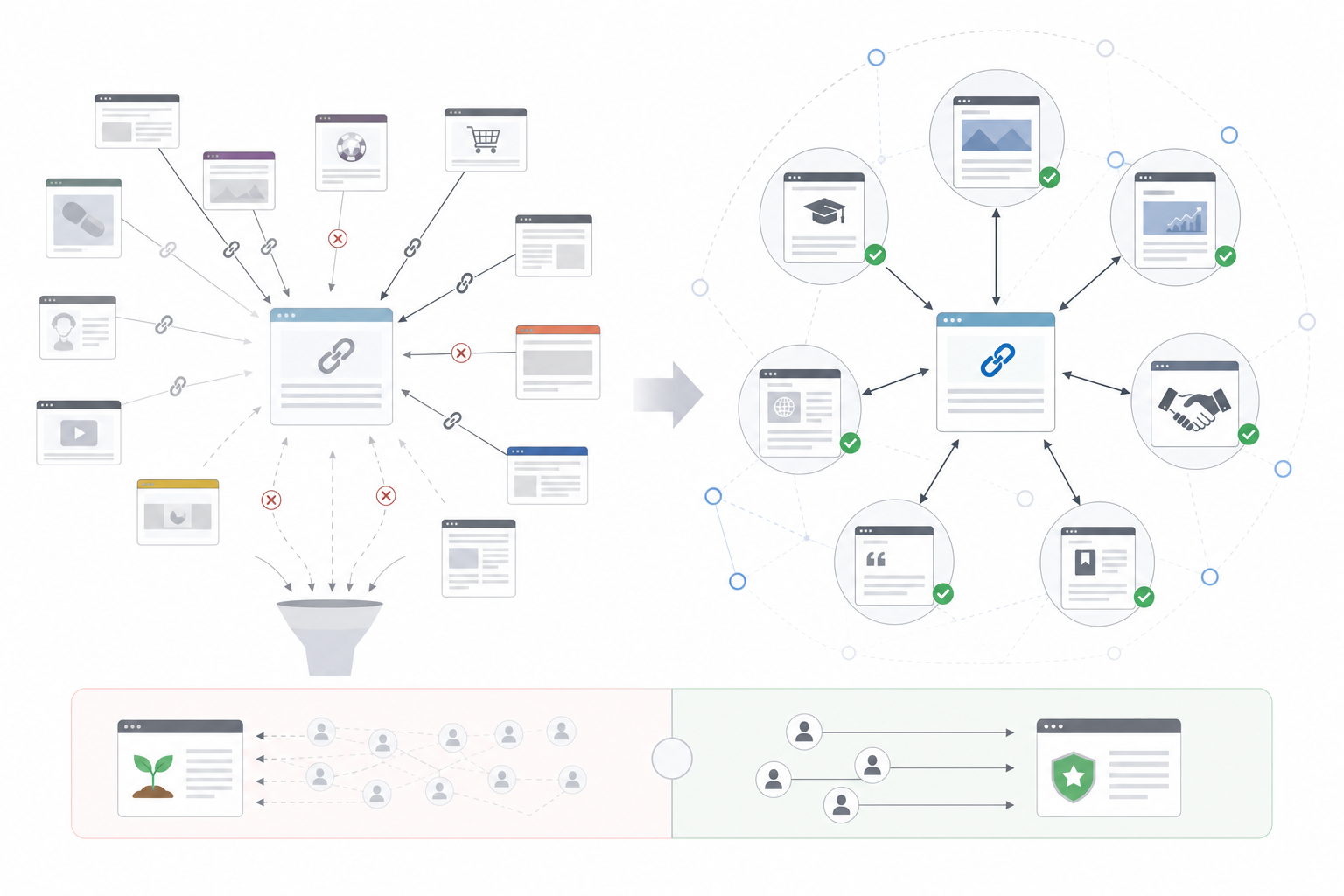
Yes. Link building remains relevant to SEO because search engines still use link relationships within broader systems for understanding webpages and the web, but modern link building is increasingly focused on legitimate contextual references rather than raw backlink volume. Its priority depends on competition, site maturity, brand strength, existing links, content quality, and the search opportunity.
| Modern Link-Building Reality | What It Means |
|---|---|
| Links remain part of search systems | External references can still contribute to how webpages and relationships are evaluated |
| Competitive pages often have strong link profiles | Links can be one differentiating factor, but correlation does not prove causation |
| Manipulative patterns can be discounted | Increasing link count through artificial placements can produce little sustainable value |
| Editorial reason matters | The strongest question is often why the source should reference the destination |
| Page-level relevance matters | A relevant page on a broad publication can be more appropriate than an unrelated page on a niche site |
| Tool metrics are secondary | DR, DA, Authority Score, and similar scores support research but do not define link value |
| Digital PR overlaps more with link building | Research, experts, news, and data can create editorial reasons for links |
| Relationships matter | Partners, associations, suppliers, customers, and publishers can produce legitimate references |
| Not every page needs active acquisition | Some pages can rank without deliberate link-building campaigns |
| Not every site needs the same intensity | A new site in a competitive market can need more active external recognition than an established brand |
SEO without an active link-building campaign is possible.
A website can rank where:
- Competition is limited
- Search intent is highly specific
- The site already has substantial external recognition
- Internal architecture is strong
- Content provides unique value
- Natural links are earned through normal business activity
SEO without active link building is therefore different from SEO with no backlinks. A business can stop deliberate outreach and continue earning references from customers, partners, PR, research, products, or brand activity.
Modern link building increasingly emphasizes four shifts:
Quantity to relevance: Raw backlink accumulation is less useful than legitimate external references.
Metrics to context: Third-party authority scores can assist research but should not replace contextual evaluation.
Placement to editorial reason: Why a publisher links matters more than simply obtaining a URL placement.
Standalone SEO to integrated marketing: Research, PR, product marketing, partnerships, expertise, and useful resources increasingly create strong link opportunities.
How to Build Links for SEO?
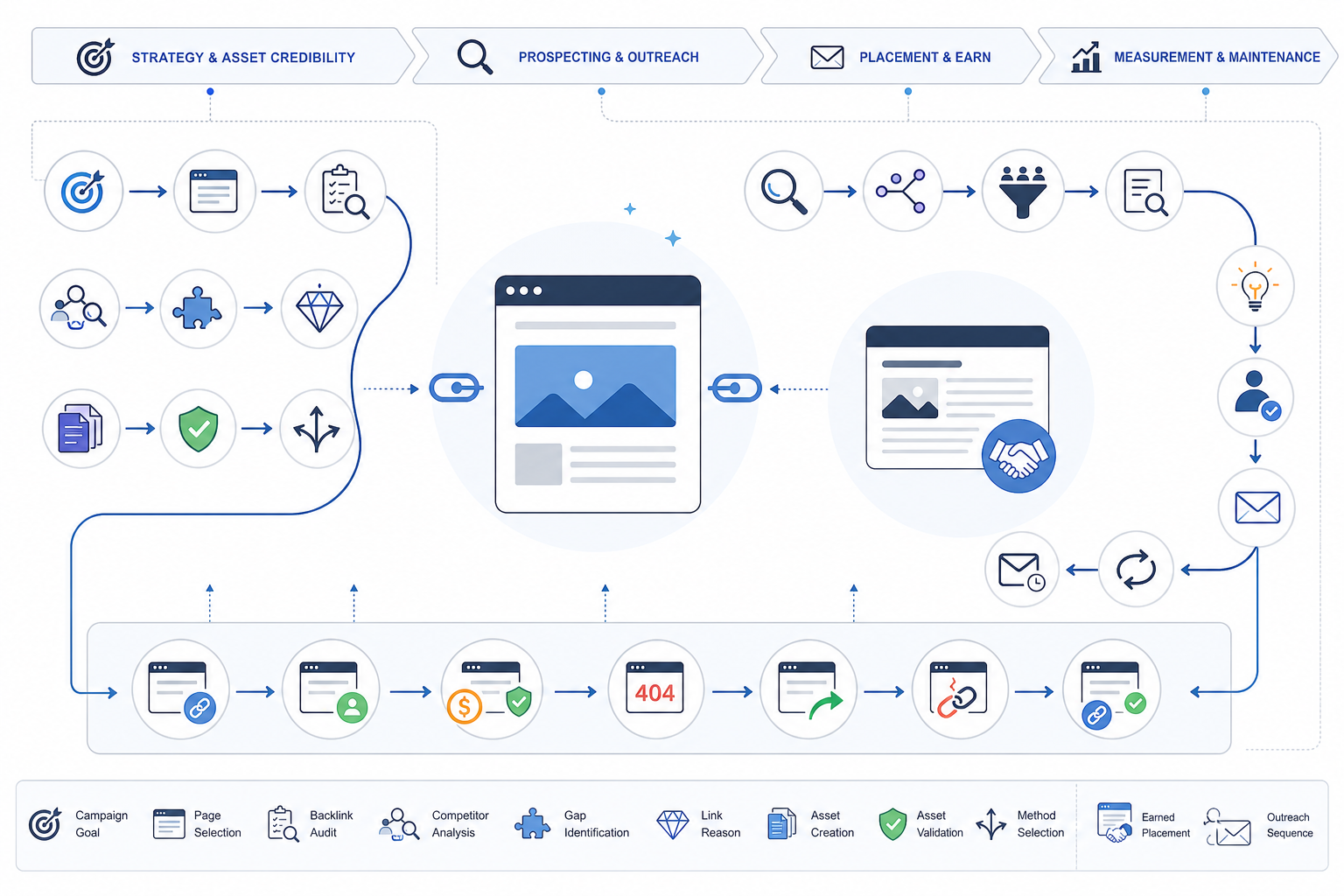
Building links for SEO means identifying pages that genuinely need external recognition, creating a credible reason for relevant publishers or businesses to reference those pages, finding suitable opportunities, earning the placement, and measuring what happens afterward. Effective link building combines research, assets, prospecting, outreach, relationships, validation, and performance analysis.
1. Define the Campaign Goal
Choose what the campaign should support.
Examples include:
- A commercial page
- A product category
- An original study
- An industry topic
- Qualified referral traffic
- Media exposure
Avoid beginning with a fixed monthly backlink quota.
2. Select the Pages That Need Links
Possible targets include:
- Service pages
- Product pages
- Category pages
- Guides
- Research
- Tools
- Statistics pages
- Documentation
Prioritize pages using business value, competition, current visibility, existing links, and realistic reference potential.
3. Analyze the Existing Backlink Profile
Review:
- Referring domains
- Linked pages
- Lost links
- Broken destinations
- Anchor patterns
- Existing business relationships
Use the analysis to understand the current situation rather than simply count links.
4. Analyze Competitor Link Relationships
Identify why competing pages receive references.
Common reasons include:
- Original data
- Media coverage
- Partnerships
- Useful tools
- Expert contributions
- Integrations
- Industry resources
Do not copy every competitor backlink mechanically.
5. Identify the External-Reference Gap
Determine what competing or successful pages possess that your website lacks.
Examples include:
- Editorial citations
- Industry relationships
- Research references
- Media coverage
- Resource-page inclusion
- Partner references
6. Determine Why Someone Would Link
A publisher needs a reason.
Examples include:
- Supporting evidence
- Useful data
- Expert commentary
- A tool
- A unique product
- Further reading
- A partnership
- A replacement resource
7. Create or Improve the Referenceable Asset
Useful assets include:
- Research
- Calculators
- Templates
- Datasets
- Benchmarks
- Guides
- Documentation
- Statistics
- Visualizations
- Case studies
Only create a new asset when it improves the campaign.
8. Validate the Asset
Check:
- Factual accuracy
- Source quality
- Research methodology
- Usability
- Internal links
- URL stability
- Actual reference value
9. Choose the Link-Building Method
Select the method according to the asset and opportunity rather than using one tactic for every campaign.
10. Research Relevant Opportunities
Potential sources include:
- Publications
- Journalists
- Resource pages
- Industry sites
- Businesses
- Associations
- Partners
- Creators
- Communities
11. Segment Prospects
Separate opportunities into useful groups such as:
- Editorial publications
- Partners
- Industry organizations
- Resource-page owners
- Journalists
- Suppliers
- Customers
- Creators
12. Prioritize Prospects
Evaluate:
- Relevance
- Editorial legitimacy
- Audience fit
- Reference reason
- Destination fit
- Probability of success
- Business value
13. Build Context Before Outreach
Understand the prospect’s page, audience, publication, resource, or business relationship before contacting them.
14. Create the Outreach Angle
Useful angles include:
- New evidence
- Updated information
- Expert insight
- Original research
- A broken-resource replacement
- A useful tool
- Partnership information
15. Personalize Where It Adds Relevance
Personalization should demonstrate why the opportunity applies to the recipient rather than add superficial details.
16. Contact the Appropriate Person
Depending on the opportunity, this can be:
- Editor
- Journalist
- Author
- Resource owner
- Partnership manager
- Business representative
- Content manager
17. Send the Outreach
A concise message should explain:
- Why you are contacting them
- What the resource or relationship is
- Why it is relevant
- Why it can help their audience
- What action you are suggesting
18. Follow Up Selectively
Use follow-ups when the opportunity is genuinely relevant.
Avoid aggressive repeated contact.
19. Earn the Placement
The final link should make sense within the source content or business relationship.
20. Use Natural Anchor Text
Natural anchors include:
- Brand name
- URL
- Product name
- Resource title
- Descriptive phrase
Avoid forcing exact-match commercial anchors.
21. Link to the Most Relevant Destination
A research citation should link to the research.
A product recommendation can link to the appropriate product page.
22. Handle Commercial Relationships Properly
Sponsored, affiliate, advertising, or paid relationships can require appropriate disclosure and link qualification.
23. Reclaim Legitimate Lost Links
Links can disappear after:
- Page edits
- URL changes
- Website migrations
- Publisher changes
- Deleted resources
Recover them when the underlying reference remains legitimate.
24. Recover Links Pointing to Broken URLs
Where a valuable external link points to an obsolete destination, restore or redirect the destination appropriately when the relationship remains valid.
25. Use Broken-Link Opportunities Selectively
Suggest a replacement only when it genuinely serves the same reader need as the unavailable resource.
26. Use Guest Contributions Selectively
Contribute useful expertise to legitimate publications where attribution or contextual references are editorially appropriate.
27. Use Digital PR for Newsworthy Opportunities
Campaigns can use:
- Original research
- Data
- Expert commentary
- Timely stories
- Product developments
- Industry analysis
28. Use Existing Business Relationships
Review genuine relationships involving:
- Suppliers
- Customers
- Partners
- Integrations
- Associations
- Distributors
- Events
- Sponsorships
29. Promote Assets Beyond Email
Distribution can include:
- PR
- Newsletters
- Communities
- Partners
- Events
- Professional groups
- Social platforms
30. Validate Acquired Links
Check that:
- The source page is live
- The destination is correct
- The context is relevant
- The anchor is natural
- Link attributes are appropriate
- The source is legitimate
31. Monitor Link Retention
Important links can disappear or change.
Monitor strategically valuable references rather than every low-value link equally.
32. Measure Referral Outcomes
Measure:
- Referral visits
- Engagement
- Leads
- Trials
- Purchases
- Revenue where attributable
33. Measure Organic Outcomes
Monitor:
- Impressions
- Rankings
- Organic clicks
- Organic traffic
- Conversions
- Target-query visibility
Avoid attributing every change solely to link acquisition.
34. Evaluate Links in Context
Review:
- Editorial reason
- Relevance
- Source quality
- Audience
- Placement
- Destination fit
- Attributes
- Legitimacy
- Referral value
35. Document Which Methods Work
Track which:
- Assets
- Campaign methods
- Prospect groups
- Outreach angles
- PR approaches
- Partnerships
produce useful outcomes.
36. Refine the Strategy
Reassess target pages, methods, assets, prospects, link gaps, competitors, and business priorities as evidence changes.
What Are the Types of Link Building in SEO?
There is no single universally fixed number of link-building types because methods can be classified by how the link is earned, why it exists, which relationship creates it, and which asset receives it. Categories also overlap; for example, an original research campaign promoted through digital PR can be both content-led and editorially earned.
- Editorial or Natural Link Earning: A publisher independently references a useful company, page, study, tool, product, or expert.
- Content-Led Link Building: Guides, templates, research, checklists, datasets, and educational resources are promoted because they provide useful reference material.
- Digital PR Link Building: News, data campaigns, research, expert commentary, and company developments earn media references.
- Expert Contribution Link Building: Specialists provide quotes, analysis, interviews, or source material to publishers.
- Guest Contribution Link Building: Experts contribute useful editorial content to relevant publications.
- Resource Page Link Building: A useful resource is suggested for a legitimate curated-resource page.
- Broken-Link Building: A relevant replacement is suggested where a publisher already links to an unavailable resource.
- Link Reclamation: A previously valid backlink is restored after a URL change, migration, page edit, or other issue.
- Unlinked Mention Reclamation: An existing legitimate brand, product, study, or expert mention is reviewed for possible citation linking.
- Contextual Link Addition: A relevant existing article gains a new reference where the destination genuinely improves the content.
- Partnership Link Building: Real customers, suppliers, partners, and co-marketing relationships create appropriate references.
- Integration Link Building: Connected software products or platforms reference their integration relationship.
- Supplier or Vendor Link Building: Commercially connected companies reference genuine suppliers or vendors.
- Association Link Building: Professional memberships and industry relationships generate legitimate profile or resource references.
- Sponsorship Link Building: Real sponsorships can result in acknowledgement pages or event references.
- Event Link Building: Speakers, sponsors, venues, exhibitors, and organizers can receive relevant event references.
- Directory Link Building: Legitimate directories list businesses for discovery and reference.
- Local Link Building: Local publications, organizations, events, chambers, and community resources reference nearby businesses.
- Industry Link Building: Industry publications and specialist resources reference relevant companies or content.
- Competitor-Gap Link Building: Competitor links are studied to identify relationships or opportunities missing from the target website.
- Skyscraper-Style Link Building: Existing resources are improved through fresher evidence, better methodology, stronger usability, or greater utility before relevant publishers are approached.
- Statistics and Data Link Building: Original or well-sourced statistics provide publishers with evidence to cite.
- Tool-Based Link Building: Calculators, generators, databases, templates, and utilities attract references because they solve a problem.
- Visual Asset Link Building: Original diagrams, charts, illustrations, and visualizations can receive attribution or editorial references.
- Case Study Link Building: Distinctive project results or customer outcomes can be cited by partners, publications, and industry sources.
- Podcast and Interview Links: Show notes, interviews, and expert profiles can reference the participant or supporting resources.
- Community Link Building: Legitimate community participation can create references through professional groups or ecosystem contributions.
- Social Distribution for Link Earning: Social distribution can expose a resource to writers or publishers who may later cite it.
- User-Generated References: Real users can link from community content where the reference is useful and policy compliant.
- Image Attribution Links: Original media can earn source attribution when reused appropriately.
- Research Citation Links: Writers and researchers cite the original source of a study, methodology, dataset, or statistic.
- Product or Service Recommendation Links: Editorial reviews, comparisons, and buying resources can reference relevant commercial pages.
- Affiliate Links: Publishers link to products or services through commercial affiliate relationships that require appropriate disclosure and qualification.
- Sponsored Links: Paid sponsorship or advertising references should be represented according to applicable policies.
- Citation or Reference Links: Writers link to sources supporting a claim, definition, methodology, statistic, quotation, or factual statement.
These categories describe how link relationships can arise. They should not be treated as a checklist requiring every website to use every method.
How to Find Keywords for Link Building?
Link-building keyword research has two distinct purposes: finding search topics or pages that may benefit from external references, and finding prospecting queries that help locate publications, journalists, resources, organizations, or other potential link sources. The first purpose overlaps with keyword research for SEO because both assess search demand, intent, competition, current visibility, and business relevance before deciding which pages deserve priority. Prospecting queries are not necessarily keywords the target website wants to rank for.
1. Start With the Page or Topic
Identify the product, service, category, guide, tool, research asset, or subject the campaign should support.
2. Review Existing Query Visibility
Use sources such as Search Console, rank trackers, or keyword platforms to identify:
- Current rankings
- Near-page-one opportunities
- Declining queries
- Important topic clusters
- Commercially relevant searches
3. Identify High-Value Search Opportunities
Consider:
- Relevance
- Business value
- Intent
- Current position
- Competition
- Conversion potential
- Strategic importance
Search volume alone should not determine the campaign.
4. Compare Competing Pages
Review:
- Page relevance
- Content quality
- Intent fit
- Internal linking
- Technical accessibility
- External references
5. Identify Genuine External-Reference Gaps
Look for differences in:
- Editorial citations
- Referring publications
- Industry relationships
- Media coverage
- Research citations
- Linkable assets
6. Identify Topics That Naturally Attract Citations
Examples include:
- Statistics
- Benchmarks
- Trends
- Definitions
- Research
- Comparisons
- Methodologies
- Calculators
- Datasets
- Technical documentation
7. Research Citation-Oriented Queries
Useful query families can include:
- [topic] statistics
- [topic] research
- [topic] data
- [topic] study
- [topic] survey
- [topic] benchmark
- [topic] report
- [topic] source
8. Validate Linkability
Check whether publishers genuinely cite external resources in the topic.
Identify whether they reference:
- Original data
- Tools
- Definitions
- Visuals
- Research
- Expert analysis
9. Identify Evidence Gaps
Possible opportunities include:
- Outdated statistics
- Missing recent benchmarks
- Fragmented information
- Weak visual explanations
- Missing calculators
- Limited original research
10. Separate Ranking Keywords From Asset Keywords
A commercial page can target a search term while a related research asset targets the information publishers need to cite.
These two functions do not always belong on the same URL.
11. Build Prospecting Query Families
Useful prospect groups include:
- Publications
- Journalists
- Associations
- Resource pages
- Partners
- Suppliers
- Directories
- Universities
- Communities
- Events
12. Find Resource Pages
Combine the topic with terms such as:
- resources
- useful links
- tools
- guides
- references
13. Find Relevant Publications
Examples include:
- [topic] magazine
- [topic] publication
- [topic] news
- [topic] journal
- [topic] blog
14. Find Contributor Opportunities
Search for relevant publications that genuinely accept expert contributions.
15. Find Journalists and Experts
Combine the topic with roles such as:
- Journalist
- Reporter
- Editor
- Analyst
- Researcher
- Columnist
- Podcast host
16. Find Associations and Organizations
Useful patterns include:
- [industry] association
- [profession] organization
- [industry] chamber
- [topic] society
17. Find Relevant Directories
Use directories only where they have a legitimate business, professional, geographic, or industry purpose.
18. Find Broken-Link Opportunities
Search for pages containing outdated or unavailable resources that match the destination closely.
19. Research Competitor Assets
Search competitors by:
- Brand
- Research
- Reports
- Tools
- Products
- Proprietary terms
- Experts
20. Research Partnerships
Search for product ecosystems, integration partners, suppliers, distributors, and complementary businesses.
21. Add Geographic Terms Where Relevant
Geographic modifiers can be useful for local organizations, publications, associations, and events.
22. Use Search Operators Carefully
Operators such as site:, intitle:, inurl:, quoted phrases, and exclusions can narrow discovery.
23. Expand With Related Entities
Add:
- Products
- Problems
- Audiences
- Industries
- Roles
- Use cases
- Related terminology
24. Review Search Results Manually
Check whether:
- The page is current
- The source is legitimate
- The audience is relevant
- External references already exist
- Your destination would fit naturally
25. Validate Every Prospect
Evaluate:
- Page relevance
- Audience
- Editorial quality
- Business purpose
- Relationship fit
- Destination fit
- Legitimacy
26. Segment Prospects by Opportunity Type
Examples include:
- Resource pages
- Journalists
- Associations
- Partners
- Editorial publications
- Broken-link prospects
- Product recommendations
27. Prioritize Search Opportunities by Business and Link Value
A high-volume keyword with little business relevance can be a weaker campaign target than a smaller term connected with an important product or service.
28. Map Queries to Link Opportunities
Maintain a working map connecting each priority page or topic with relevant publisher types, potential reference reasons, and acquisition methods.
What Are Examples of Link Building?
Link-building examples should show why an external source would reasonably reference another page, not simply where a backlink appears. Strong examples share one characteristic: the backlink still makes sense to the reader even if SEO ranking value is ignored.
| Situation | What the Business Does | Why the External Site Links | Destination |
|---|---|---|---|
| Original Industry Study | A SaaS company publishes survey data on remote-work software adoption | A journalist needs a primary source for a statistic | Original research page |
| Free Calculator | A finance platform creates a useful repayment calculator | A personal-finance guide recommends a tool for readers | Calculator |
| Expert Commentary | A cybersecurity expert provides analysis for a journalist | The article attributes the expert source | Expert or company resource |
| Broken Resource Replacement | A publisher links to an unavailable industry guide | The company offers a genuinely equivalent updated resource | Replacement guide |
| Unlinked Brand Mention | A publication discusses a company but does not link | The publisher adds the website as a useful source reference | Relevant company page |
| Integration Partnership | Two SaaS products launch a functional integration | Each company documents the integration for users | Integration page |
| Supplier Relationship | A manufacturer lists an authorized distributor | Buyers need to identify where products are available | Distributor page |
| Association Membership | A consultancy joins a relevant professional association | The association maintains a legitimate member directory | Company profile |
| Research Statistics Page | A company maintains sourced, current industry statistics | Writers need evidence for factual statements | Statistics page |
| Case Study | A partner documents a successful project involving the company | The partner credits the technology or service used | Case-study or service page |
| Podcast Appearance | An expert appears on an industry podcast | Show notes cite the guest and supporting resources | Expert or company page |
| Editorial Product Review | A publication independently evaluates a product | Readers need a destination to learn more about the product | Product page |
A backlink obtained through a genuine business, editorial, research, or resource relationship is structurally different from an artificial placement created only to manipulate rankings.
Which Tools Support Link Building for SEO?
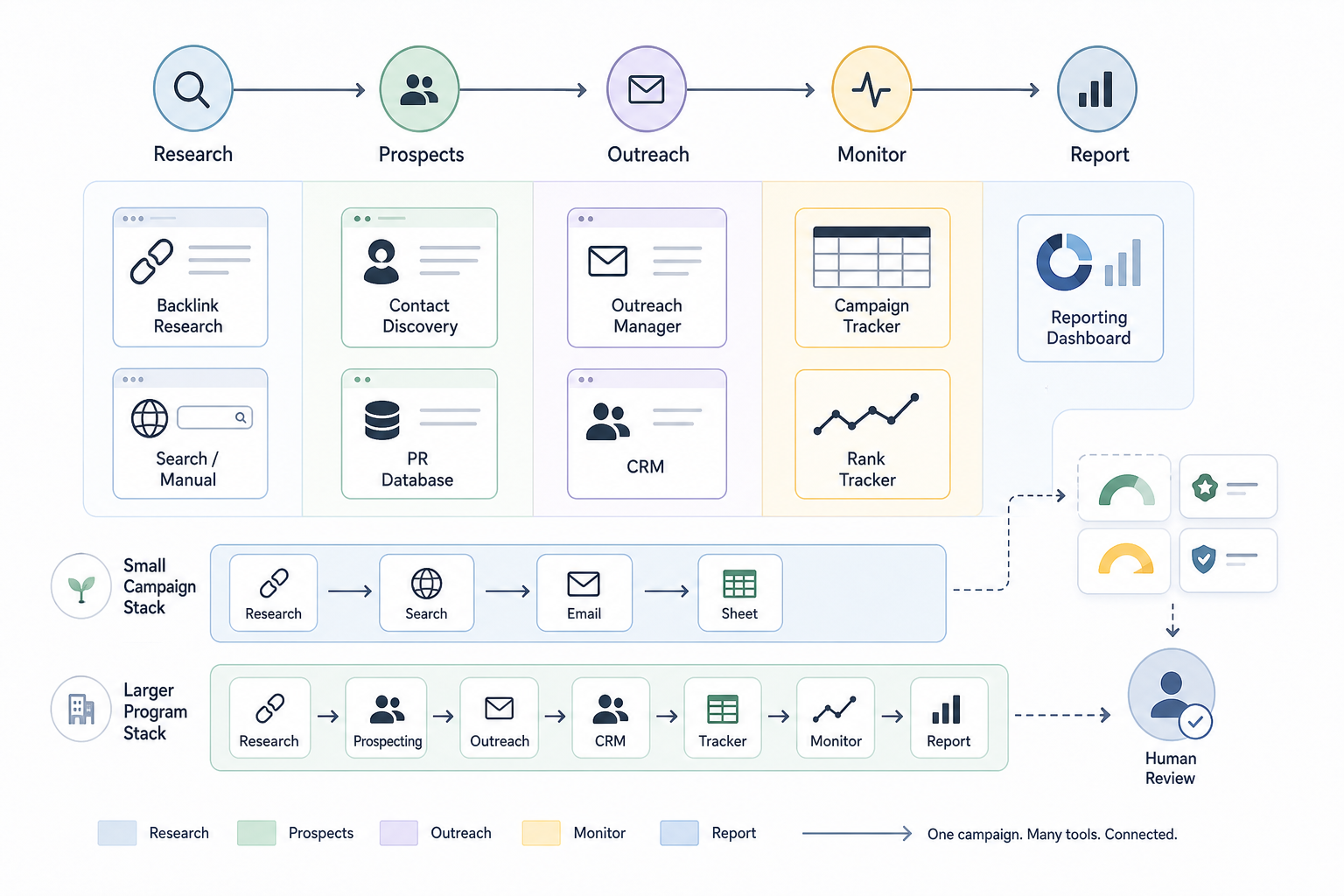
Link-building tools support backlink research, competitor analysis, prospect discovery, contact research, outreach, relationship management, link monitoring, rank tracking, and reporting. No single tool necessarily performs every stage equally well, so selection should begin with the campaign task. Because link acquisition spans research, prospecting, outreach, monitoring, and reporting, the best SEO software depends on which part of that workflow needs the strongest support.
| Tool / Tool Type | Primary Role | Useful Capability | Main Limitation |
|---|---|---|---|
| Ahrefs | Backlink and competitor research | Referring domains, linked pages, broken links, competitor links | Third-party link data is not a complete record of the web |
| Semrush | Broad SEO and backlink research | Backlink gaps, competitor research, domain analysis | Proprietary metrics remain vendor estimates |
| Majestic | Specialist backlink research | Link graph analysis, Trust Flow, Citation Flow | Trust Flow and Citation Flow are not Google metrics |
| BuzzStream | Outreach and relationship management | Prospect organization, outreach, contact history | Does not replace backlink research or strategic qualification |
| Pitchbox | Outreach workflow management | Prospecting and campaign outreach | Automation still requires relevant targeting |
| Hunter.io | Contact discovery | Professional email discovery and verification | An email address does not make a site a qualified prospect |
| Cision | PR and journalist research | Media and journalist discovery | Primarily a PR database rather than an SEO backlink tool |
| Search Engines | Manual prospect discovery | Publications, resources, partners, organizations | Requires manual qualification |
| Spreadsheets | Campaign management | Prospect lists, placements, status, reporting | Manual maintenance can become difficult at scale |
| Rank Trackers | Outcome monitoring | Query and target-page movement | Ranking changes cannot automatically be attributed to links |
A small campaign can operate with:
- One backlink-research platform
- Search engines
- A spreadsheet
A larger program can add:
- Dedicated prospecting software
- Contact discovery
- Outreach automation
- CRM functionality
- Link monitoring
- PR databases
- Reporting systems
Tool-generated metrics such as DR, DA, Authority Score, Trust Flow, estimated traffic, or backlink counts should support human evaluation rather than replace it.
What Should a Link Building Report Include?
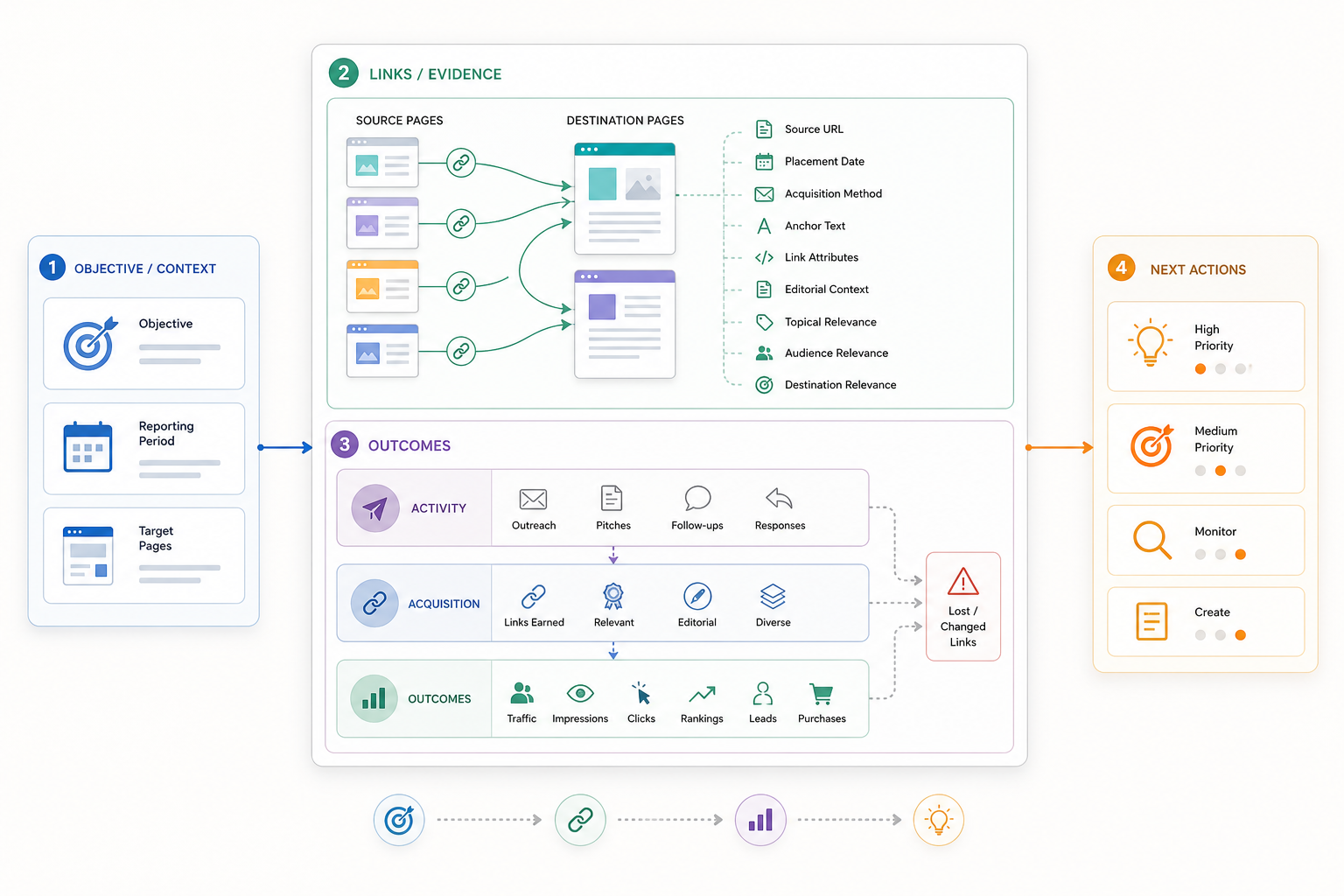
A link-building report should show which links were earned, why they are relevant, which pages they support, how the campaign performed, and what should happen next. A useful report combines placement evidence, contextual evaluation, campaign outcomes, and recommendations instead of showing only URLs and authority scores. These findings can then feed into a broader SEO report alongside organic visibility, traffic, conversions, technical changes, and other search-performance evidence.
| Report Section | What to Include |
|---|---|
| Executive Summary | Important gains, losses, placements, findings, and priorities |
| Campaign Objective | Search, referral, PR, product, or business goal |
| Reporting Period | Clearly defined date range and comparison period |
| Target Pages | Products, services, research, tools, categories, or topics being supported |
| Links Acquired | Source URL, destination URL, placement date, source page |
| Acquisition Method | PR, editorial outreach, partnership, broken-link work, contribution, reclamation |
| Reference Reason | Why the source reasonably links to the destination |
| Topical Relevance | Relationship between source topic and destination topic |
| Audience Relevance | Whether source users could reasonably care about the destination |
| Editorial Context | Article, resource list, partner page, author bio, directory, or other placement context |
| Destination Relevance | Whether the backlink points to the most logical page |
| Anchor Text | Brand, URL, title, descriptive, or other natural wording |
| Link Attributes | Followed, nofollow, sponsored, UGC where detectable |
| Referral Traffic | Visits, leads, trials, purchases, or other direct outcomes |
| Organic Performance | Impressions, clicks, rankings, organic traffic for target pages |
| Lost or Changed Links | Important links that disappeared or changed |
| Campaign Findings | Which assets, methods, prospect groups, or pitches performed well |
| Next Actions | Prioritized changes based on evidence |
A report should distinguish campaign activity from campaign outcome.
For example, sending 500 emails is an activity. Earning six relevant editorial references is an acquisition outcome. Improved rankings, referral leads, or revenue are later outcomes.
A report should also avoid claiming that a ranking gain was caused by a backlink unless sufficient evidence supports that conclusion.
What Is a Link Builder?

A link builder is an SEO or digital-marketing specialist responsible for identifying, developing, validating, and managing opportunities for external websites to reference relevant pages. The role can exist as a dedicated position, within an SEO or digital PR team, at an agency, or as part of a broader off-page SEO function.
Typical responsibilities include:
- Opportunity Research: Identify pages, products, services, or topics where external references could create useful value.
- Backlink Analysis: Review referring domains, target pages, anchors, lost links, broken links, and existing patterns.
- Competitor Analysis: Study why competing pages earn external references.
- Prospecting: Find relevant publications, journalists, resource pages, businesses, associations, partners, creators, and other potential sources.
- Prospect Qualification: Evaluate topical fit, editorial quality, audience, legitimacy, destination fit, and reference reason.
- Contact Research: Identify the editor, journalist, writer, resource owner, or business contact relevant to the opportunity.
- Outreach Planning: Develop a pitch based on why the destination helps the recipient or audience.
- Outreach Execution: Send relevant messages and manage reasonable follow-ups.
- Relationship Management: Maintain legitimate relationships with publishers, partners, journalists, businesses, creators, and industry contacts.
- Asset Coordination: Work with writers, designers, researchers, developers, or experts to improve research, tools, guides, case studies, data, or other referenceable resources.
- Digital PR Coordination: Support media campaigns involving original data, experts, stories, or research.
- Guest Contribution Coordination: Identify appropriate publications for useful expert contributions.
- Resource-Page Outreach: Find curated resource pages where a company asset genuinely belongs.
- Broken-Link Research: Identify missing resources that have suitable replacements.
- Reclamation: Recover useful links lost through migrations, URL changes, or page edits.
- Placement Validation: Confirm that acquired links are live, contextually appropriate, and point to the correct destination.
- Monitoring: Track important link gains, losses, and changes.
- Reporting: Connect campaign activity with links, referral traffic, organic performance, and business outcomes where measurable.
A link builder is therefore not simply someone who “gets backlinks.” The role combines SEO research, digital research, communication, editorial judgment, relationship management, quality control, and measurement.
What Is a Link Building Service?
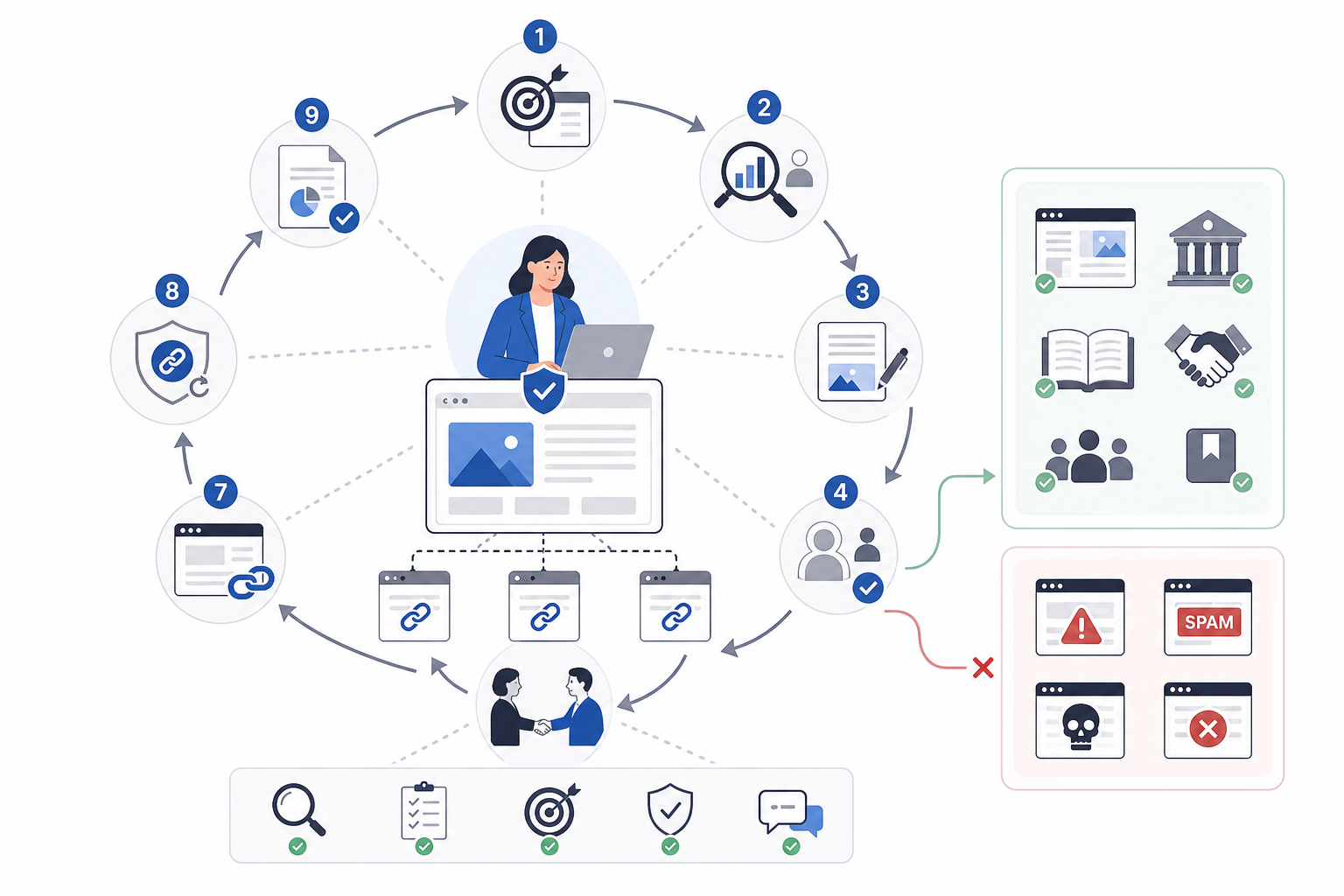
A link building service is a professional SEO or digital-marketing offering in which an agency, consultant, specialist, or managed provider helps a business plan, research, acquire, validate, monitor, and report legitimate external links. The provider can manage all or part of the process depending on the engagement scope.
A professional service can include:
- Link-Building Strategy: Define target pages, business priorities, campaign types, relevant industries, opportunities, and measurement criteria.
- Backlink Profile Analysis: Review referring domains, linked pages, anchors, lost links, broken links, and suspicious patterns.
- Competitor Link Analysis: Identify publications, resources, organizations, and relationships that reference competitors.
- Target-Page Prioritization: Select commercial pages, categories, products, research, tools, guides, or other assets with a clear reason for external support.
- Linkable Asset Planning: Develop research, statistics pages, calculators, reports, tools, templates, case studies, and other resources where needed.
- Content Coordination: Create or coordinate material required for research, PR, expert contribution, or supporting campaigns.
- Prospecting: Identify publications, businesses, associations, journalists, partners, and resource owners.
- Prospect Qualification: Evaluate relevance, editorial quality, audience, reference reason, and legitimacy.
- Contact Discovery: Find appropriate editors, journalists, authors, content managers, partnership contacts, or business representatives.
- Outreach: Introduce relevant assets, experts, data, business relationships, or replacement resources.
- Follow-Up Management: Manage reasonable communication after the initial message.
- Publisher Relationship Management: Maintain genuine relationships with relevant publications, companies, creators, and industry contacts.
- Digital PR: Use original research, expert commentary, data, and newsworthy campaigns to earn editorial attention.
- Broken-Link Building: Identify relevant unavailable resources and suggest legitimate replacements.
- Link Reclamation: Recover links lost through URL changes, migrations, or publisher edits.
- Guest Contribution Support: Coordinate useful expert contributions to legitimate publications.
- Partnership Link Development: Identify genuine opportunities through suppliers, partners, integrations, customers, associations, or events.
- Link Monitoring: Track important acquired links and identify meaningful losses.
- Reporting: Document placements, relevance, target-page performance, referral traffic, and campaign findings.
A professional service should not be evaluated only by a promised number of links.
Important evaluation criteria include:
- Methodology
- Transparency
- Prospect quality
- Editorial legitimacy
- Target-page relevance
- Reporting
- Ownership of campaign assets
- Communication
- Policy compliance
- Business fit
A provider promising guaranteed rankings, guaranteed traffic, or fixed SEO results from a defined number of backlinks is making a claim that link acquisition alone cannot support.
Where Can You Learn Link Building?
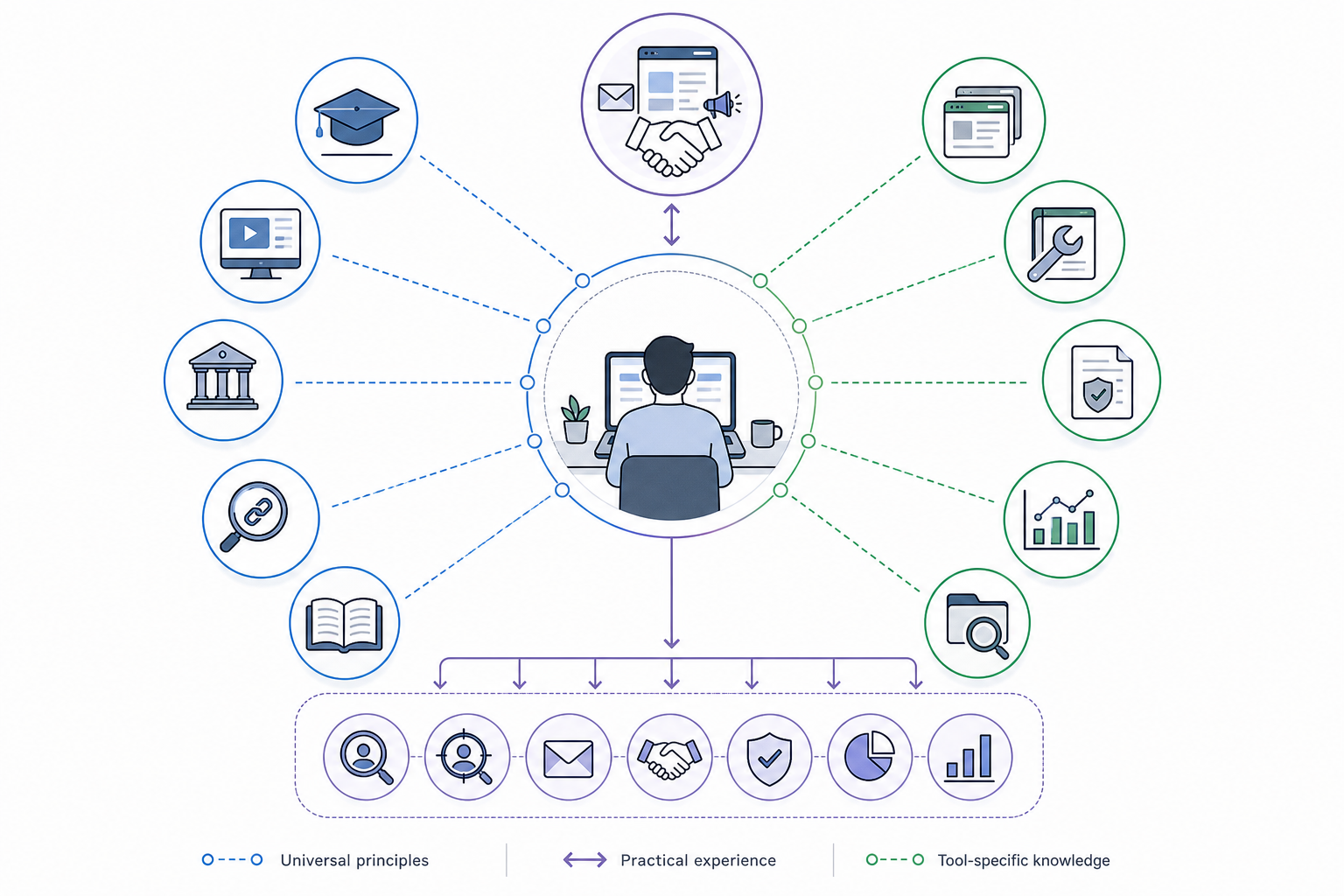
Link building can be learned through structured courses, SEO platform education, official search-engine documentation, beginner and advanced guides, specialist blogs, case studies, tool documentation, and practical campaign experience. No single course or publication covers research, prospecting, outreach, PR, relationship development, policy, analysis, and measurement equally well.
Structured Courses
Formal courses can help learners understand:
- Backlink fundamentals
- Prospecting
- Outreach
- Competitive analysis
- Campaign measurement
Course quality depends on the instructor, publication date, curriculum, and practical depth.
Marketing Education Platforms
Platforms such as HubSpot Academy and broader marketing-training providers can be useful for learning adjacent skills such as:
- Inbound marketing
- Outreach
- Content promotion
- PR
- Relationship marketing
Exact course availability can change.
University and Marketplace Courses
Platforms such as Coursera can provide structured learning around:
- SEO fundamentals
- Search marketing
- Analytics
- Competitive research
- Digital marketing
The platform name alone does not guarantee that every course is current or advanced.
SEO Platform Learning Hubs
Platforms such as Semrush and Ahrefs publish educational material covering:
- Backlink analysis
- Competitive research
- Broken-link building
- Content-led acquisition
- Outreach
- Link metrics
- Campaign workflows
Tool-specific recommendations should be separated from universal SEO principles.
Backlink-Specialist Education
Majestic and other specialist platforms can help learners understand:
- Link graphs
- Referring domains
- Backlink profiles
- Proprietary metrics
Metrics such as Trust Flow or Citation Flow should be understood as tool-specific models rather than Google ranking factors.
Beginner Guides
Beginner material should establish concepts such as:
- Backlinks
- Referring domains
- Anchor text
- Editorial links
- Link relevance
- Prospecting
- Outreach
- Link quality
Understanding the concepts first makes tool usage easier to evaluate.
Advanced Guides
Experienced practitioners can study:
- Competitive backlink analysis
- Digital PR
- Linkable assets
- Link reclamation
- Publisher relationships
- Campaign analytics
- Scaled outreach operations
More automation does not automatically make a method advanced.
Link Building Blogs
A useful link building blog can provide:
- Experiments
- Campaign breakdowns
- Industry discussions
- Tactical updates
- Failures
- Practitioner experience
Compare multiple credible sources rather than relying on one publisher.
Link Building Articles
Focused link building articles are useful for specific subjects such as:
- Broken-link building
- Prospect qualification
- Link reclamation
- Digital PR
- Outreach
- Link quality
Individual articles are useful learning units but not a complete curriculum.
Tool Documentation
Documentation can teach operational tasks such as:
- Backlink-gap analysis
- Lost-link monitoring
- Anchor review
- Prospect filtering
- Contact discovery
- Campaign tracking
Tool documentation explains how software works; it does not automatically establish why a link-building methodology is strategically correct.
Search-Engine Documentation
Official documentation is essential for understanding:
- Link spam
- Sponsored relationships
- Link qualification
- Search policies
- Crawling and indexing fundamentals
This helps separate published search-engine guidance from industry assumptions.
Case Studies
Useful case studies should reveal:
- Campaign objective
- Target page
- Asset
- Prospect type
- Acquisition method
- Links earned
- Search or referral outcomes
- Limitations
One successful case study does not prove that the same method will work in every market.
Practical Campaign Experience
Link building ultimately requires practice in:
- Research
- Prospect qualification
- Outreach
- Communication
- Relationship management
- Editorial judgment
- Measurement
The most useful learning combines SEO fundamentals with real campaigns because link building depends on whether a genuine external reference makes sense for the source, destination, audience, and business context.
Need links on real SaaS and business websites?
Links are placed after your approval, on sites with guaranteed DR and traffic, with a 1-year replacement guarantee.

