
How SEO Builds Organic Visibility and Search Growth
 By Saurav Agarwal
Last updated
By Saurav Agarwal
Last updated
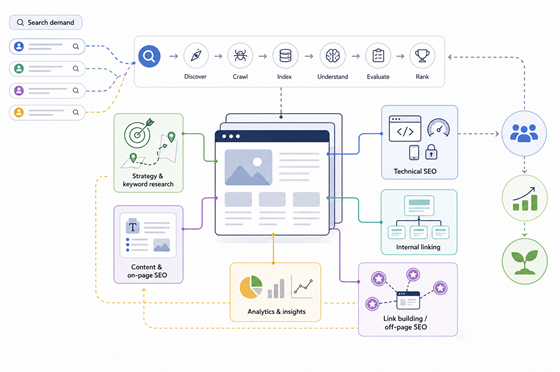
Search engine optimization, or SEO, is the process of improving how a website is discovered, understood, accessed, evaluated, and selected in organic search.
SEO connects relevant search demand with webpages capable of satisfying it. Doing that requires more than publishing content or targeting keywords. Search engines need to discover and process a website, understand what individual pages provide, determine whether those pages satisfy a particular search need, compare them with other eligible results, and decide where they should appear.
Several connected areas support this process.
SEO marketing connects organic search with business and marketing goals. SEO rankings show where pages appear for specific searches. SEO strategy determines which opportunities deserve attention. Search intent, keyword research, and competitor analysis establish what people search for and what those searches require.
Different types of SEO apply that understanding across webpages, technical systems, locations, business models, scalable page systems, and newer search environments. Internal linking connects related pages within the website, while link building develops relevant external relationships. SEO analysis, analytics, audits, reporting, and tools then help teams understand performance and decide where further optimization is needed.
What Is SEO and How Does It Work?
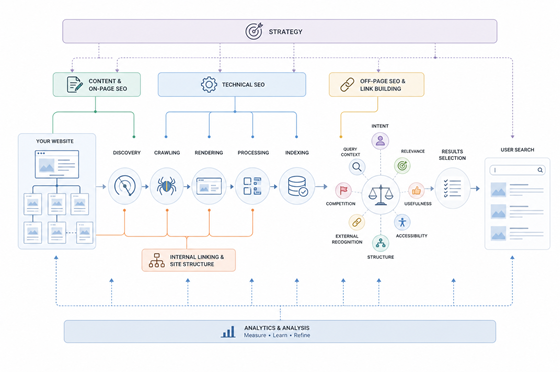
SEO improves a website's ability to appear for relevant searches without purchasing individual organic placements.
For a webpage to compete in organic search, search engines first need to discover it. Eligible pages can then be crawled, rendered, processed, and indexed. When a user searches, ranking systems evaluate relevant indexed information and determine which results should be served.
Different parts of SEO support different stages of this process.
Content gives search engines and users information to interpret. On-page SEO clarifies a page's topic, purpose, and relevance. Technical SEO supports reliable access and processing. Internal links connect pages and help communicate website structure. Off-page SEO and link building establish relationships with external sources. Strategy determines where these activities should be applied, while analytics and analysis show whether the resulting visibility is useful.
SEO does not guarantee a particular ranking. Organic performance depends on factors such as search intent, relevance, usefulness, accessibility, website structure, external recognition, competition, and the requirements of the individual query.
That makes SEO both a search discipline and a marketing discipline.
What Is SEO Marketing?
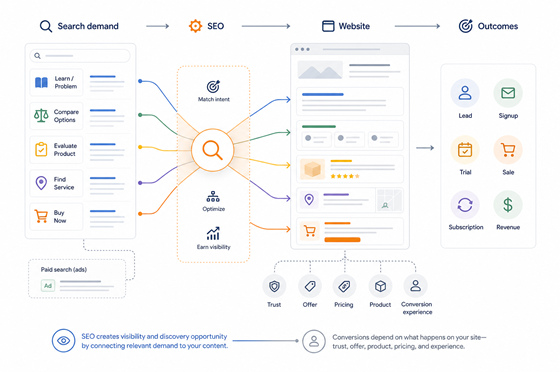
SEO Marketing is the use of search engine optimization to connect relevant organic search demand with a website, its content, and defined business goals.
It belongs within digital marketing because search engines are digital discovery channels. Unlike paid search, SEO primarily focuses on unpaid organic visibility rather than purchasing individual clicks or placements.
Search demand can represent different stages of a customer journey. Someone may be trying to understand a problem, compare possible approaches, evaluate products, find a service, or make a purchase. SEO marketing identifies where that demand is relevant to the business and develops website experiences capable of satisfying it.
The value of SEO marketing therefore extends beyond rankings and traffic. Relevant organic visibility can contribute to product or service discovery, qualified visits, leads, sign-ups, trials, sales, subscriptions, pipeline, and revenue.
Whether those outcomes occur depends on more than search visibility alone. SEO can create the opportunity for discovery, while the website, product, pricing, offer, trust, and conversion experience influence what happens afterward.
Before organic visibility can create those opportunities, webpages first need to compete within search results.
How Are SEO Rankings Determined?
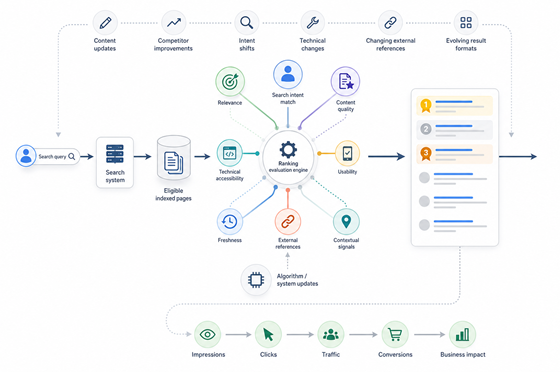
SEO Ranking refers to the position a webpage holds in organic search results for a particular query.
Ranking occurs after discovery and indexing. Search systems retrieve eligible content and evaluate which results are most relevant and useful for the search being performed.
There is no single universal ranking factor that determines every search position. Different queries can require different combinations of relevance, intent satisfaction, content quality, technical accessibility, usability, freshness, external references, and other signals.
Rankings are also contextual and dynamic. A page can gain or lose visibility because its content changes, competing pages improve, search intent shifts, external references change, technical conditions change, search demand changes, search-result formats evolve, or ranking systems are updated.
Ranking positions are useful performance indicators, but they are not the final objective. Their value depends on whether stronger visibility produces relevant impressions, clicks, traffic, conversions, and business outcomes.
Improving those outcomes systematically requires a plan.
What Is an SEO Strategy?
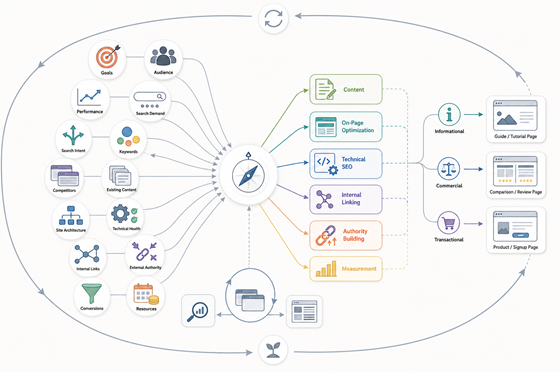
An SEO Strategy is a coordinated plan for increasing relevant organic visibility and turning that visibility into meaningful business outcomes.
Rather than treating content, technical work, keywords, internal links, and backlinks as independent activities, an SEO strategy determines what deserves investment, why it matters, what should be done, and how success should be evaluated.
A strategy can consider business goals, target audiences, current organic performance, search demand, search intent, keywords, competitors, existing content, website architecture, technical health, internal relationships, external authority, conversion opportunities, and available resources.
These inputs are converted into priorities across content, on-page optimization, technical SEO, internal linking, authority building, and measurement.
SEO strategy is not static. Search demand changes, competitors improve, business priorities shift, existing pages gain or lose visibility, and search environments continue to evolve.
A useful strategy therefore begins with understanding why people search, what they search for, and what already competes for that demand.
What Is Search Intent in SEO?
Search Intent SEO focuses on understanding the underlying goal a user wants to accomplish through a search.
A searcher may want to learn something, reach a particular destination, compare possible options, find a product or service, or complete an action.
The same subject can represent very different intent.
Someone searching for “CRM software” may be exploring the category. “Best CRM software for startups” suggests comparison. “CRM software pricing” moves closer to product evaluation.
The topic remains related, but the appropriate page and information change.
Search intent therefore connects a query with the type of content, page, functionality, and information required to satisfy it.
How Does Content Match Search Intent?
Content matches search intent when its purpose, format, depth, and information correspond with what the user is trying to accomplish.
An informational query can require an explanation, tutorial, guide, calculator, or another useful resource.
A commercial query may require comparisons, alternatives, reviews, features, benefits, pricing context, or evaluation criteria.
A transactional query may be better served by a product page, service page, category page, pricing page, signup page, booking flow, or purchasing experience.
Intent also affects how information is arranged. The primary answer or functionality should normally appear where the user can access it easily, while supporting questions can follow in a logical sequence.
Matching search intent is therefore not about mentioning a keyword more frequently. It is about creating the appropriate destination for the task represented by the search.
How Does Keyword Research Work in SEO?
SEO Keyword Research is the process of discovering, analysing, and prioritising the searches people use when looking for information, products, services, or solutions.
Keyword research turns audience search behaviour into practical SEO opportunities.
Search volume can help estimate demand, but volume by itself does not establish value. A useful keyword opportunity also depends on relevance, search intent, topical connection, competitive conditions, ranking potential, traffic potential, and business value.
Related searches can then be grouped according to whether they represent the same underlying need.
Some keyword variations belong on one page because users expect substantially the same result. Others need separate pages because the intent, subject, or required experience changes.
Keyword research therefore helps determine which topics deserve coverage, which searches belong together, which pages are required, and how those pages should be structured and optimized.
Competitive evidence can then help validate those decisions.
How Does Competitor Analysis Support Keyword Research?
SEO Competitor Analysis studies websites competing for the same relevant organic search visibility.
An SEO competitor does not have to be a direct business competitor.
A software company, for example, may compete in organic search with other software companies, review websites, publishers, marketplaces, forums, and educational resources.
Competitor research can reveal which queries generate visibility, which pages attract that demand, which search intents competitors satisfy, which content formats repeatedly appear, and where meaningful keyword or topic gaps exist.
It can also reveal differences in backlinks, website architecture, and technical implementation.
The objective is not to copy competitors. Their performance provides evidence about existing search demand, current competitive standards, and areas where a stronger or more useful result may be possible.
Once strategy establishes what should be targeted, the next distinction is how SEO is applied across different website and search contexts.
What Are the Types of SEO?
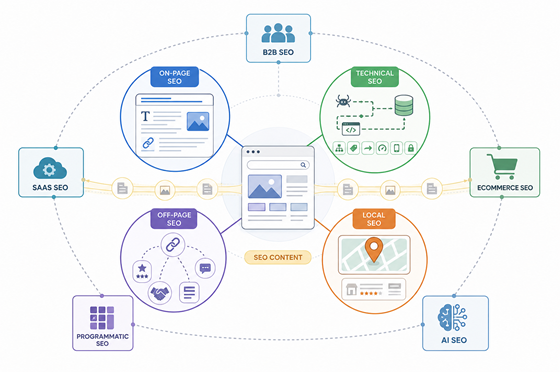
SEO Types describe different areas, applications, and methods of search engine optimization.
They are not all equivalent classifications.
The four core optimization areas are On-Page SEO, Technical SEO, Off-Page SEO, and Local SEO.
On-Page SEO focuses on page-level relevance and optimization. Technical SEO focuses on technical accessibility and search-engine processing. Off-Page SEO focuses on external authority, references, and reputation. Local SEO focuses on searches where geographic relevance changes which result is most useful.
Other SEO labels classify the discipline according to a different context.
B2B SEO, SaaS SEO, and Ecommerce SEO adapt SEO to particular business models, audiences, and customer journeys.
Programmatic SEO describes a scalable production model for creating and maintaining families of search-focused pages.
AI SEO describes both the use of artificial intelligence within SEO workflows and optimization for search experiences that generate, retrieve, or synthesize information.
SEO Content also sits within this wider system, but it should not be treated as another core SEO type. Content operates across multiple types and business applications.
A SaaS website, for example, can simultaneously use SaaS SEO, On-Page SEO, Technical SEO, Off-Page SEO, SEO Content, Programmatic SEO, and AI-assisted workflows.
The appropriate combination depends on the website, business model, audience, search demand, technical requirements, and competitive environment.
How Does SEO Content Help Rankings?
SEO Content is content created and organized to satisfy relevant search intent while helping search engines understand what a webpage provides.
Content connects search demand with useful information or functionality.
Depending on the query, SEO content can include explanations, guides, product pages, service pages, category pages, comparisons, tools, calculators, original research, documentation, videos, and other useful resources.
The appropriate format depends on what satisfies the search.
SEO content therefore goes beyond inserting keywords into text. Useful content combines search-intent alignment, relevant information, clear structure, natural terminology, internal relationships, credibility, and an appropriate format.
Content helps establish relevance, but it does not work independently. Technical accessibility, page-level optimization, website structure, external signals, and competition can all influence whether a page becomes visible.
SEO Content is best understood as a cross-cutting SEO practice that can operate within On-Page, Local, B2B, SaaS, Ecommerce, and other forms of SEO.
What Is On-Page SEO?
On Page SEO is the practice of optimizing an individual webpage so its content, targeting, structure, and page-level signals clearly communicate its topic and relevance.
It focuses primarily on what happens within the page itself.
On-page SEO can involve search intent, content quality, keyword targeting, page titles, headings, URLs, images, descriptive elements, and contextual links.
These elements work together rather than functioning as isolated optimization checks.
A page with an optimized title but information that does not satisfy the query remains poorly aligned. Similarly, adding keywords does not compensate for an unclear page purpose.
Effective on-page SEO makes it easier for users and search systems to understand what the page covers, what need it addresses, and how its information is organized.
That differs from Technical SEO, which focuses on whether search systems can reliably access and process the page.
What Is Technical SEO?
Technical SEO is the practice of optimizing the website infrastructure and configuration required for search engines to reliably discover, crawl, render, interpret, and index important webpages.
Technical SEO can involve crawlability, indexability, rendering, website architecture, URL handling, HTTP status behaviour, redirects, canonicalization, XML sitemaps, JavaScript, mobile accessibility, page performance, HTTPS, and structured data.
Its role is different from content relevance.
Technical SEO asks whether a page can be reliably accessed and processed. On-page SEO asks whether that accessible page clearly communicates the appropriate topic, intent, relevance, and usefulness.
A technically healthy website does not automatically rank.
Technical SEO establishes the conditions under which relevant and useful pages can participate effectively in organic search.
What Is Off-Page SEO?
Off-Page SEO covers optimization activities and signals that occur beyond the website and contribute to its external visibility, reputation, recognition, and competitiveness.
Backlinks are an important off-page signal, but off-page SEO is broader than backlink acquisition.
External signals can also include Digital PR, editorial coverage, brand mentions, partnerships, citations, reviews, community visibility, and industry references.
These relationships provide something a website cannot create entirely through its own pages: third-party recognition.
On-Page SEO develops page relevance. Technical SEO supports access and processing. Off-Page SEO focuses on the external environment surrounding those pages and the brand behind them.
Link building is one of the main activities within that external environment and is covered separately because it has its own processes, methods, and supporting systems.
What Is Local SEO?
Local SEO improves organic visibility for searches where geographic location affects which business, service, product, or physical location is relevant.
Local SEO can influence visibility across conventional organic results, Google Maps, local packs, Google Business Profiles, location pages, and service pages.
A query does not always need to contain a city or the phrase “near me” to have local intent.
Searches such as “dentist,” “pharmacy,” “restaurant,” or “car repair” can produce geographically influenced results because proximity and local availability matter to the user.
Local SEO can apply to physical-location businesses, service-area businesses, and multi-location organizations.
It combines broader SEO principles with local business information, business profiles, reviews, citations, locally relevant pages, backlinks, and geographic signals.
The defining characteristic is that location materially influences which result is useful.
What Is B2B SEO?
B2B SEO applies SEO to search demand generated by people researching products, services, software, suppliers, or solutions for a business purpose.
The defining difference is the buying context.
A B2B searcher may be an end user, manager, technical evaluator, procurement professional, finance stakeholder, operations professional, executive, or another person involved in the buying process.
The person conducting the search may only be one participant in a longer decision.
That changes how keyword value should be interpreted. A relatively low-volume search can have substantial business value when it represents a high-value requirement, technical need, vendor comparison, or purchasing decision.
B2B SEO therefore connects organic search with problem research, solution discovery, commercial evaluation, vendor comparison, and longer purchasing journeys.
What Is SaaS SEO?
SaaS SEO applies established SEO principles to the product, customer journey, and recurring-revenue model of software-as-a-service businesses.
Relevant SaaS search demand can exist around customer problems, software categories, features, use cases, integrations, comparisons, alternatives, documentation, and product information.
Different searches represent different levels of product awareness and commercial relevance.
A SaaS website can therefore use educational resources, feature pages, integration pages, solution pages, comparison pages, alternative pages, documentation, and other product-led search assets.
The objective is not simply to increase organic traffic.
SaaS SEO connects relevant search demand with pages that can support product discovery, evaluation, trials, demos, sign-ups, subscriptions, and other SaaS outcomes.
What Is Ecommerce SEO?
Ecommerce SEO improves an online store's organic search visibility so relevant products, categories, brands, collections, and informational resources can appear when shoppers search.
Searchable ecommerce assets can include categories, subcategories, products, brands, collections, comparisons, buying guides, and supporting informational resources.
The appropriate landing page depends on shopper intent.
A broad product search may require a category containing multiple suitable products. A search for an exact model can require a detailed product page containing information such as price, availability, variants, specifications, images, and purchasing details.
Ecommerce SEO also introduces structural and technical complexity because online stores can contain products, categories, filters, variants, attributes, pagination, inventory states, and large URL inventories.
The purpose of ecommerce SEO is to connect shopper search demand with the most relevant store resource the business can genuinely provide.
What Is Programmatic SEO?
Programmatic SEO is the systematic creation and maintenance of search-focused page families using repeatable search needs, structured data, reusable page logic, and automated or semi-automated production.
Instead of creating every page independently, programmatic SEO identifies a search pattern that repeats across changing entities or attributes.
Examples can include software integrations, services by location, jobs by city, currency conversions, product compatibility, and recurring entity-based datasets.
Structured data supplies the changing information, while templates and reusable logic determine how each page is assembled.
Automation by itself does not make a system programmatic SEO.
The pages still need to address genuine recurring search needs and contain meaningful differences that justify separate search destinations.
Programmatic SEO is therefore a production model for scaling useful search experiences rather than a substitute for On-Page SEO, Technical SEO, Internal Linking, or content quality.
What Is AI SEO?
AI SEO has two related dimensions.
The first is the use of artificial intelligence within SEO activities such as research, classification, content workflows, data analysis, internal-link analysis, reporting, and automation.
The second is optimization for AI-assisted search experiences where systems retrieve, generate, or synthesize information from web sources.
AI SEO therefore extends beyond AI-generated content.
Artificial intelligence can support keyword clustering, SERP analysis, content briefing, dataset analysis, classification, metadata workflows, pattern detection, reporting, and repetitive SEO operations.
These capabilities can increase execution capacity, but they do not remove the need for search demand, strategy, factual accuracy, useful information, technical accessibility, and human validation.
How Is AI Changing SEO?
AI is changing both how people search and how SEO work can be performed.
Searchers can express longer, more contextual, and multi-part requests. Search systems can interpret those requests, reformulate them, retrieve supporting information, and present synthesized responses.
Visibility can therefore extend beyond a conventional ranking position to include referenced URLs, citations, brand mentions, and other AI-assisted discovery surfaces.
At the same time, AI can automate or accelerate repetitive SEO work involving classification, analysis, content operations, monitoring, and reporting.
These changes expand the search environment rather than replacing SEO fundamentals.
Websites still need relevant and useful information, accessible pages, coherent architecture, clear relationships, credible sources, and measurable performance.
With the main SEO areas and applications established, another important part of the website is how those pages connect with one another.
How Does Internal Linking Help SEO?
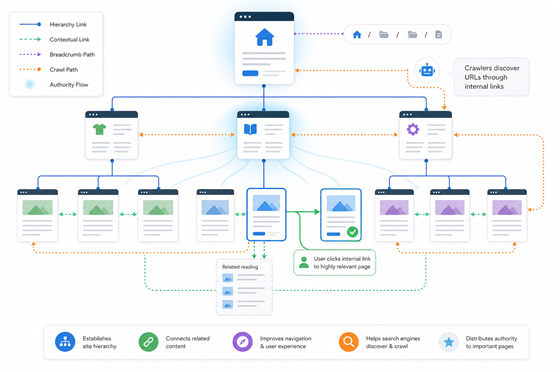
Internal Linking SEO connects one webpage with another relevant webpage on the same website.
Internal links support both navigation and SEO.
They can help search engines discover URLs, establish crawl paths, understand relationships between pages, identify website hierarchy, and distribute internal PageRank across the site.
For users, internal links provide a natural path from one relevant piece of information toward another.
Internal links can appear through contextual body links, main navigation, breadcrumbs, categories, related-content modules, sidebars, calls to action, footers, and linked images.
The most useful internal link exists because the destination logically supports the source page or the user's next information need.
Internal linking is therefore another cross-cutting SEO system. It can support On-Page SEO, Technical SEO, Ecommerce SEO, SaaS SEO, Programmatic SEO, content architecture, and the wider user journey.
Internal links describe relationships within the website. Links coming from external websites create a different type of relationship.
What Is Link Building in SEO?
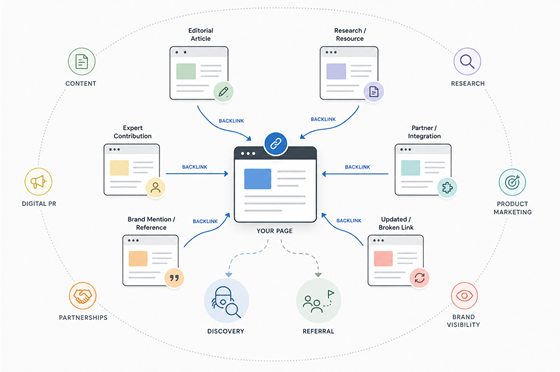
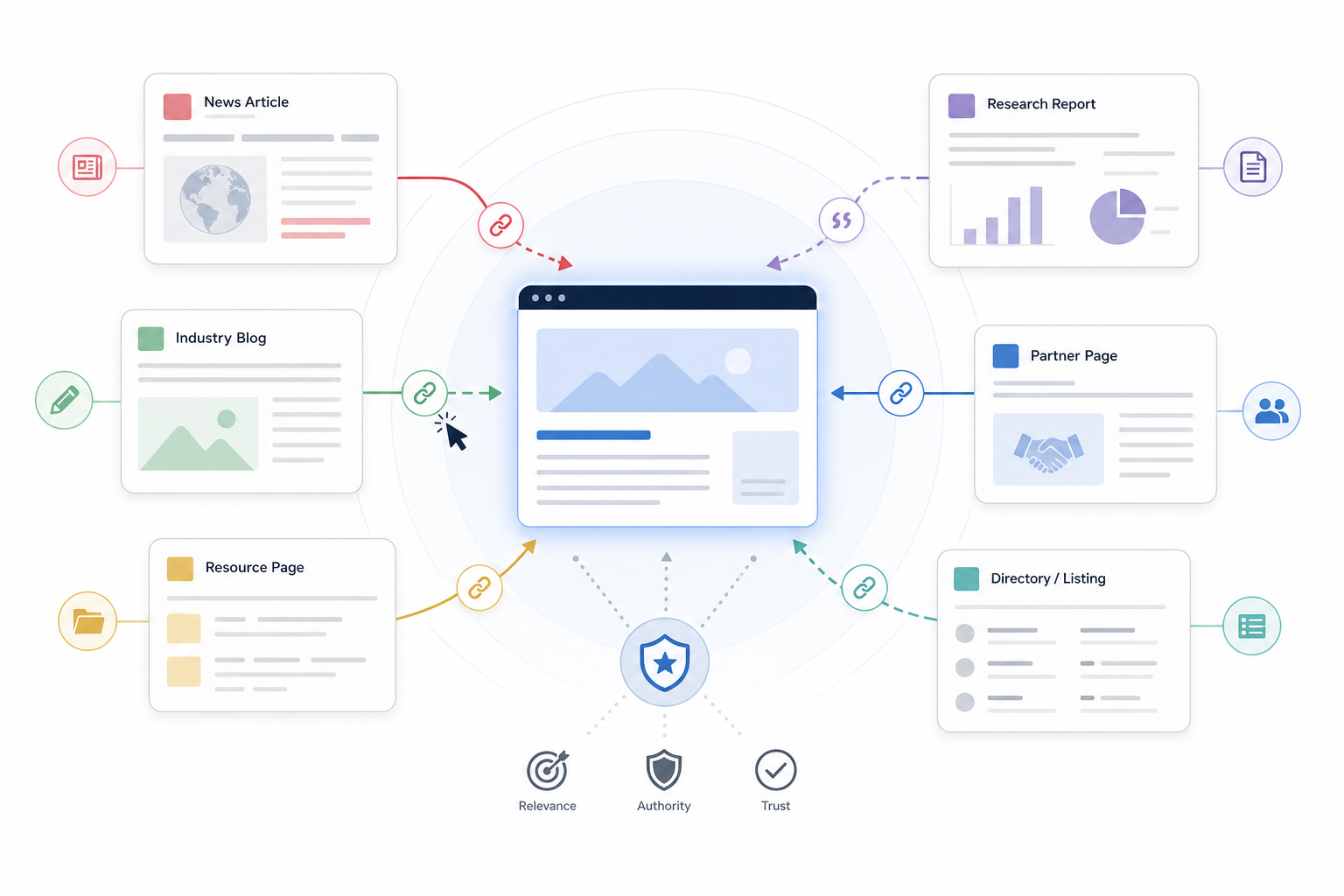
SEO Link Building is the practice of earning, acquiring, recovering, or developing relevant hyperlinks from external webpages to pages on your own website.
Those incoming external links are backlinks.
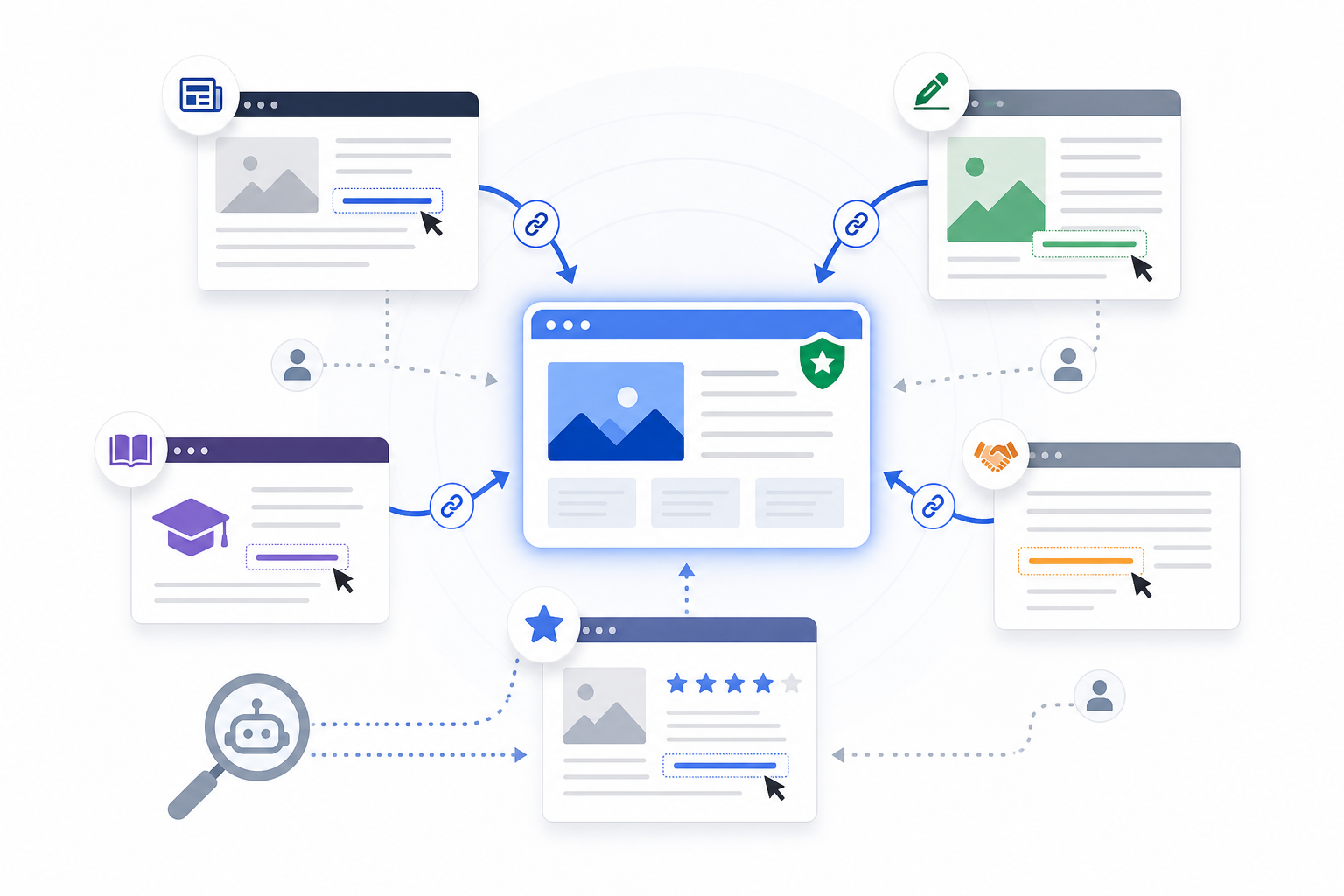
A backlink connects a source page on another website with a destination page on your website.
Search engines can encounter these links while processing the web. Links can contribute to page discovery and provide contextual information about relationships between sources and destinations. Users can also follow them directly, creating referral traffic and audience discovery.
Modern link building should not be reduced to accumulating the largest possible number of backlinks.
A legitimate external reference normally exists because the source has a reason to cite something, recommend something, identify a company or product, credit a source, reference expertise, provide supporting information, or represent a genuine business relationship.
Relevant link opportunities can emerge from research, useful assets, Digital PR, expert contributions, integrations, partnerships, resource pages, broken references, existing mentions, and other legitimate reasons for an external website to reference a destination.
Link building sits primarily within Off-Page SEO while also overlapping with content, PR, partnerships, research, product marketing, and brand visibility.
Once SEO activities are being implemented, their performance needs to be evaluated and interpreted.
What Is SEO Analysis?
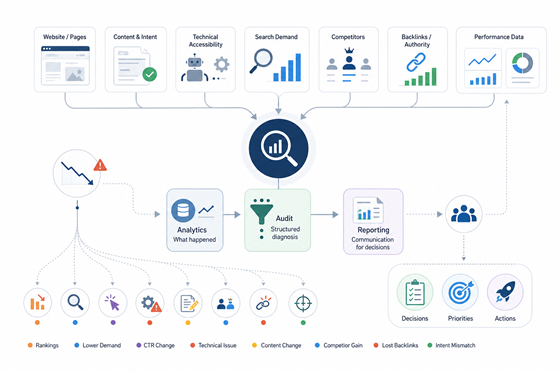
SEO Analysis is the process of evaluating a website's search condition and organic performance to understand what supports visibility, what restricts it, and where meaningful optimization opportunities exist.
Performance metrics show outcomes. SEO analysis investigates the conditions behind those outcomes.
A decline in organic traffic, for example, could relate to lower rankings, reduced search demand, weaker click-through rates, technical accessibility problems, content changes, competitor improvements, lost backlinks, search-result changes, or poor intent alignment.
Looking at traffic alone cannot identify which explanation is correct.
SEO analysis therefore considers evidence from the website, individual pages, content, technical systems, search demand, competitors, backlinks, and performance data.
Within this analytical system, analytics measures and organizes performance evidence, audits perform structured diagnosis, and reporting communicates the findings to the people who need to act on them.
How Is SEO Performance Measured?
SEO Analytics is the process of collecting, measuring, organizing, and interpreting organic-search data.
It creates the evidence base used to understand performance.
SEO analytics can include search impressions, clicks, click-through rate, rankings, organic traffic, landing-page performance, user behaviour, conversions, revenue or pipeline, technical health, backlinks, content performance, and competitor data.
Different metrics answer different questions.
More impressions do not automatically mean more clicks. More traffic does not automatically mean more conversions. Higher rankings do not automatically mean more revenue.
Effective SEO performance measurement therefore considers visibility, traffic, website behaviour, conversion activity, and business outcomes together rather than relying on one metric.
Analytics primarily establishes what happened.
SEO analysis then investigates why it happened and what may require attention.
What Is an SEO Audit?
An SEO Audit is a systematic evaluation of a website that identifies issues and opportunities affecting organic search visibility, accessibility, relevance, content quality, and authority.
An audit can examine areas such as technical accessibility, on-page optimization, keyword targeting, content quality, internal relationships, and external authority.
The purpose is not to generate the longest possible list of warnings.
Automated tools can identify potential problems, but those findings need to be validated and interpreted according to their actual effect on important pages and business objectives.
A useful audit distinguishes material problems from minor observations and false positives. It should also identify which issues affect crawling, indexation, search relevance, content performance, authority, conversions, or other important outcomes.
The final output should turn evidence into prioritized actions.
An audit therefore functions as a structured diagnostic process within the wider SEO analysis system.
What Is an SEO Report?
An SEO Report organizes and communicates relevant organic-search information so stakeholders can understand performance and decide what to do next.
A useful SEO report is more than a dashboard export.
It should explain what changed, where the change occurred, which pages or topics contributed, what SEO work occurred during the period, which problems or opportunities matter, and what should happen next.
Reporting can combine information about visibility, traffic, rankings, conversions, technical health, content, backlinks, and completed work.
The required level of detail depends on the audience.
SEO specialists may require page-level evidence and diagnostic data. Business stakeholders may need trends, conversions, commercial outcomes, major risks, and prioritized actions.
Analytics establishes the evidence. Analysis interprets that evidence. Audits investigate structured problems. Reporting communicates the information required for decisions.
All of these activities depend on appropriate data sources and software.
What SEO Tools Are Used?
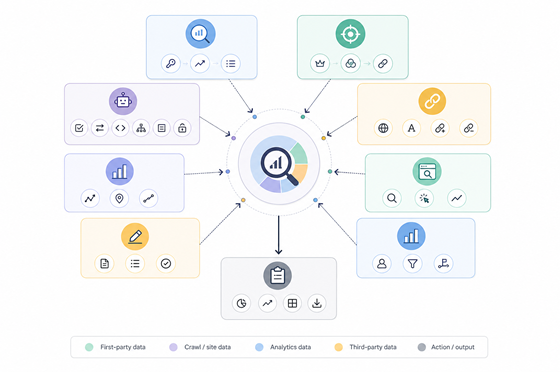
SEO Tools are software platforms and data sources used to research, diagnose, execute, monitor, and report different parts of SEO.
No single tool is strongest at every task because different SEO questions require different datasets.
Keyword research tools can support search-demand discovery and prioritization.
SERP and competitor tools can provide evidence about competing pages, keywords, backlinks, and visibility.
Technical crawlers can identify patterns involving status codes, redirects, canonicals, internal links, metadata, indexability, and website architecture.
Backlink tools can provide information about external links, referring domains, anchor text, competitors, new links, and lost links.
Rank trackers can monitor selected keywords over time.
Search-engine platforms such as Google Search Console provide first-party search-performance information for verified websites.
Analytics platforms such as Google Analytics can measure what users do after reaching the website.
Content tools can support content research and optimization, while reporting systems can combine information from several sources for recurring stakeholder communication.
These data sources should not be treated as interchangeable.
First-party search data, website analytics, crawl information, and third-party modeled datasets each answer different questions.
SEO tools provide evidence, scale, diagnostics, monitoring, and workflow support. Strategy and analysis still determine what that evidence means and which actions deserve priority.
In this section
SEO
Need links on real SaaS and business websites?
Links are placed after your approval, on sites with guaranteed DR and traffic, with a 1-year replacement guarantee.

