
White Hat Link Building: 25 Strategies & How It Differs From Grey and Black Hat
 By Saurav Agarwal
Last updated
By Saurav Agarwal
Last updated
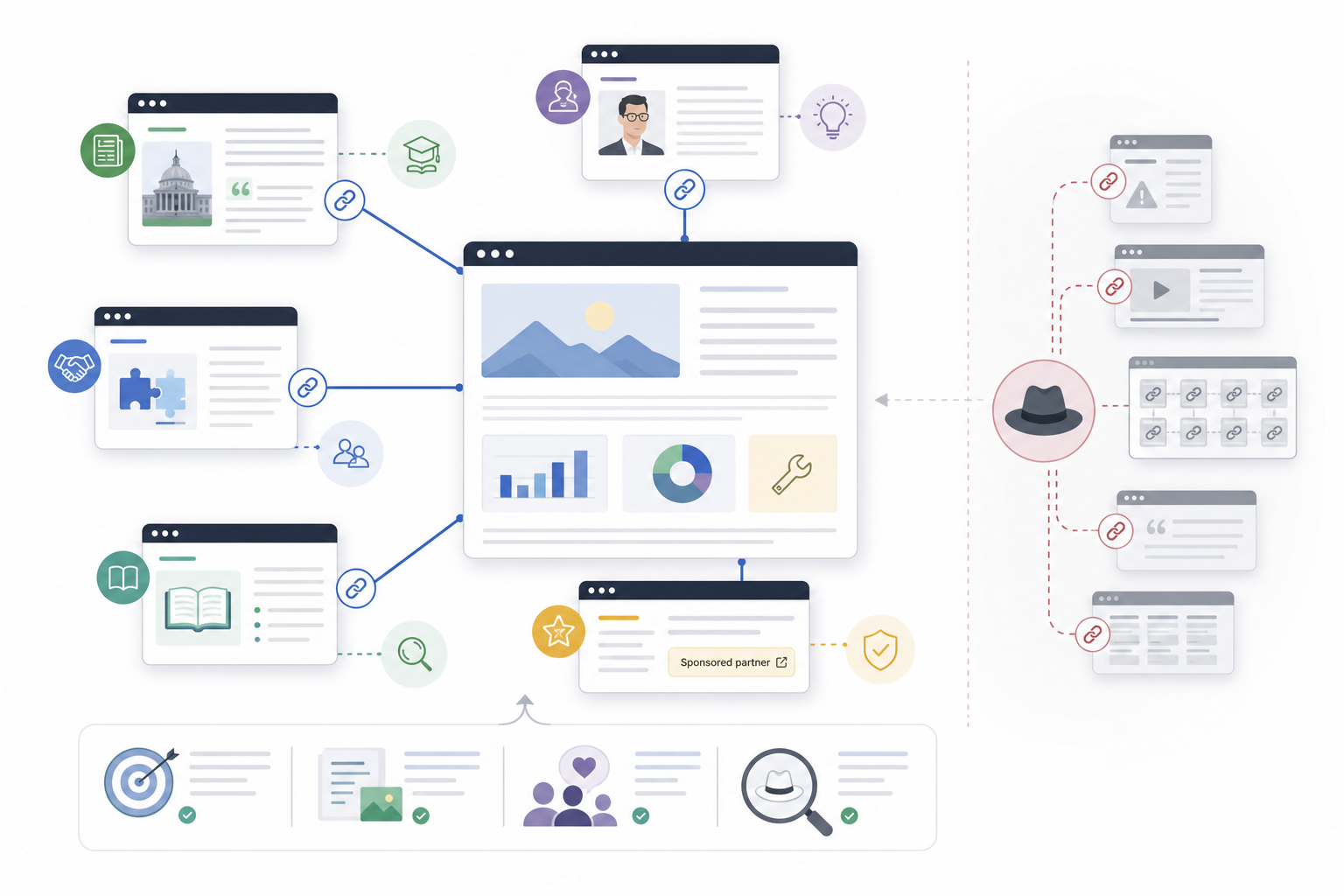
White hat link building is the practice of earning, developing, or acquiring backlinks through legitimate methods where another website has a genuine editorial, user, business, or reference reason to link. The backlink exists because the reference is useful or appropriate, rather than primarily to manipulate search rankings.
The defining principle is not whether the backlink was obtained through outreach, digital PR, a partnership, a guest contribution, or independent discovery. The more important question is why the external source links to the destination in the first place. A legitimate backlink should still make sense to the publisher or reader even if its potential ranking value were removed.
That reference reason can come from several forms of value, such as original research, useful information, expert knowledge, practical tools, product relevance, attribution, real business relationships, or industry participation. For example, a journalist can cite an original study, a software partner can reference an integration page, and an industry publication can credit an expert source.
White hat link building can therefore be proactive. A company can promote research, contact relevant publishers, contribute expert commentary, reclaim lost references, develop partnerships, or introduce useful resources to appropriate websites. Promotion does not make a backlink manipulative when the external source retains a legitimate reason and meaningful discretion to include the reference.
A white hat approach generally depends on four characteristics:
- Relevance: The source page, destination, audience, topic, product, or business relationship creates a logical connection.
- Legitimacy: The source and relationship have a genuine purpose beyond creating ranking signals.
- User Value: The backlink helps readers identify, verify, access, compare, understand, or explore something relevant.
- Transparency: Commercial relationships, such as sponsorships, affiliate arrangements, or advertising, are represented appropriately rather than disguised as independent editorial recommendations.
White hat link building is primarily concerned with external backlinks. Legitimate backlinks can contribute to external discovery, contextual relationships between webpages, link-based search systems, ranking competitiveness, referral traffic, brand exposure, media visibility, and audience discovery. None of these outcomes is guaranteed by an individual backlink.
A high Domain Rating, Domain Authority, Authority Score, or similar third-party metric does not make a backlink white hat. A high-metric website can participate in a manipulative arrangement, while a smaller industry publication can provide a highly relevant and legitimate reference. These metrics can support research, but they do not define the acquisition relationship.
White hat link building also works within a wider SEO system. Backlinks cannot indefinitely compensate for weak content, mismatched search intent, inaccessible pages, poor site architecture, weak products, or inappropriate destination pages. External recognition is one part of search competitiveness rather than a replacement for the page itself.
The appropriate white hat approach depends on what the business can genuinely offer. A company with proprietary data can develop research-led campaigns. A company with experienced specialists can contribute expert commentary. A SaaS business can use integrations and partner relationships. A brand already receiving media coverage can reclaim relevant unlinked mentions.
White hat link building is therefore defined less by one specific tactic and more by whether the resulting backlink has a legitimate reason to exist independently of manipulating search rankings.
What Are White Hat Backlinks?
White hat backlinks are external links earned or acquired through legitimate methods that prioritize editorial relevance, user value, real business relationships, useful information, or genuine reference needs rather than ranking manipulation. “White hat” describes the acquisition philosophy and relationship behind the link; it is not an HTML attribute or technical backlink type.
A white hat backlink can be evaluated through five primary criteria.
| Criterion | What White Hat Looks Like | Warning Sign | Why It Matters |
|---|---|---|---|
| Reference Reason | The source has a genuine reason to cite, recommend, identify, or reference the destination | The backlink exists mainly because someone wanted a ranking signal | Establishes why the link belongs |
| Relevance | The source, destination, audience, topic, product, or relationship logically connects | Relevance is stretched only to justify placement | Keeps the reference contextually useful |
| Legitimacy | The source has a real editorial, business, organizational, professional, or community purpose | The source exists mainly to publish SEO links | Separates real references from manufactured inventory |
| Transparency | Commercial or organizational relationships are represented appropriately | Paid or controlled relationships are disguised as independent editorial references | Clarifies the nature of the relationship |
| User Value | The link remains useful to readers even without ranking value | The link adds nothing to the user experience | Tests whether the backlink serves a purpose beyond SEO |
A Genuine Reference Reason
The strongest characteristic of a white hat backlink is a legitimate reason for the source to reference the destination.
Examples include:
- Citing evidence
- Crediting original research
- Recommending a useful resource
- Referencing an expert
- Identifying a product
- Documenting a partnership
- Linking to further information
- Directing users to a useful tool
A backlink should not be classified as white hat merely because no money changed hands.
User Value
A useful test is simple: Would the reference still make sense to the reader if search-ranking value did not exist?
A link to the original source of a statistic helps readers verify the evidence. A link to an integration page helps users understand how two products work together. A link to a product being reviewed helps readers inspect that product directly.
These references have a user purpose independent of SEO.
Editorial or Organizational Legitimacy
Legitimate backlinks do not have to come only from journalists or major publications.
Valid sources can include:
- Businesses
- Associations
- Universities
- Customers
- Partners
- Professional directories
- Industry publications
- Communities
- Specialist resources
The source should have a genuine reason to exist beyond selling or manufacturing backlinks.
Contextual Relevance
Relevance should be assessed at the relationship level rather than simply asking whether both websites belong to the same niche.
A broad technology publication can contain a highly relevant page about CRM software. A CRM-focused website can also contain an unrelated page where the link makes little contextual sense.
Useful relevance can come from the:
- Source page
- Destination page
- Audience
- Topic
- Product
- Entity
- Business relationship
Destination Relevance
The backlink should point to the page that best satisfies the reference.
For example:
- A research citation should point to the original study.
- A tool recommendation should point to the tool.
- A product recommendation should point to the relevant product.
- A company reference can point to an appropriate company page.
Forcing every opportunity toward a commercial landing page can weaken the actual citation relationship.
Source Legitimacy
A suitable source normally has real content, users, editorial standards, commercial purpose, organizational activity, or another identifiable function.
Third-party SEO metrics can assist evaluation, but they should not replace it.
A DR 80 site is not automatically legitimate for every backlink opportunity, and a DR 30 specialist publication is not automatically low quality.
Editorial Choice
For editorial references, the external source should retain meaningful control over:
- Whether to link
- Where to link
- Which destination to use
- How to describe the destination
- Which anchor to use
- Whether the reference remains live
This does not mean a company cannot suggest the most relevant source or correct a factual error. It means the publisher should not be treated simply as a controllable backlink-placement mechanism.
Natural Anchor Context
White hat backlinks do not require predetermined exact-match anchors.
Natural anchor text can include:
- Brand names
- Product names
- URLs
- Resource titles
- Page titles
- Descriptive wording
The anchor should fit the sentence and accurately identify or describe the destination.
There is no required percentage of branded, exact-match, partial-match, or naked-URL anchors that makes a backlink profile white hat.
Appropriate Placement
A useful backlink should appear where its purpose makes sense.
A research citation can belong within an article body. A partner reference can belong on a partner page. A professional member link can belong in an association directory.
A body-content backlink is therefore not automatically superior to every directory, partner, association, or navigation reference.
A Real Asset or Entity
The destination should represent something worth referencing, such as:
- A company
- A product
- A service
- A study
- An expert
- A tool
- A dataset
- A useful guide
- An organization
Superficial pages created only to manufacture outreach opportunities provide a weaker basis for legitimate acquisition.
A Transparent Relationship
Commercial relationships can produce legitimate links, but they should not be disguised.
Relevant commercial contexts include:
- Advertising
- Affiliate partnerships
- Sponsorships
- Paid collaborations
- Product compensation
Where appropriate, these relationships can require disclosure or link qualification.
A commercially influenced link is not the same semantic class as an independent editorial citation.
No Artificial Link Network
Private networks, fabricated editorial publications, controlled link networks, and websites created mainly to sell ranking influence should not be considered white hat simply because their pages resemble ordinary articles.
The underlying purpose of the source matters.
No Automated Link Spam
Automation can support legitimate activities such as:
- Prospect research
- Data analysis
- Email workflow management
- Reporting
- Monitoring
It becomes a different practice when automation is used to manufacture large numbers of comments, profiles, forum posts, directories, or other backlinks primarily for ranking manipulation.
Reciprocal Links Require a Real Reason
Two businesses can legitimately link to one another.
For example, a software company can reference an integration partner, while the partner references the same integration from its own documentation.
This differs from systematic arrangements where websites exchange links primarily to increase backlink counts.
White Hat Does Not Mean “Followed”
Follow, nofollow, sponsored, and UGC describe link treatment or qualification.
They do not determine whether the acquisition itself is white hat.
A legitimate nofollow media reference can be white hat. A manipulated followed link can be the opposite.
White Hat Does Not Mean “Natural Only”
A naturally earned backlink can appear without direct outreach.
White hat backlinks can also result from proactive activity, such as:
- Relevant outreach
- Digital PR
- Expert contributions
- Asset promotion
- Partnerships
- Link reclamation
The important factor is why the external source ultimately chooses to reference the destination.
White Hat Does Not Mean “High Authority”
A backlink does not become white hat because the source has high DR, DA, traffic, or another vendor metric.
Likewise, a legitimate backlink can have little measurable impact on rankings and still remain a valid reference.
White hat backlinks are best understood through reference reason, relevance, legitimacy, transparency, and user value, not through a single SEO metric or tactic.
Which White Hat Link Building Strategies Should You Use?
The best white hat link building strategies are the methods that match a genuine business advantage, such as original data, expertise, useful resources, existing relationships, product value, or identifiable external reference opportunities. No single white hat strategy is universally best because different businesses give external publishers different reasons to link. The choice should also align with the wider SEO strategies being used to improve priority pages, because link acquisition is most useful when it supports a defined search, content, or business objective rather than operating independently.
Original Research and Data-Led Link Building
Original research creates a reference opportunity when publishers need evidence they can cite.
Useful assets include:
- Surveys
- Benchmarks
- Experiments
- Proprietary datasets
- Industry analysis
- Original statistics
This strategy fits businesses with access to meaningful data, customers, research capability, or industry information.
Its main limitation is evidence quality. Poor methodology, small or unexplained samples, promotional bias, and weak transparency reduce citation value.
Digital PR
Digital PR uses newsworthy information to attract editorial attention.
Campaign material can include:
- Original studies
- Timely data
- Company developments
- Expert commentary
- Industry analysis
- Distinctive stories
The business can identify journalists and promote the story, but publications retain control over coverage and linking decisions.
Digital PR can produce media coverage, citations, brand mentions, referral traffic, and backlinks. It should not be evaluated only through followed-link count.
Content-Led Link Building
Content-led acquisition uses genuinely useful information as the reason to link.
Examples include:
- Guides
- Frameworks
- Templates
- Checklists
- Educational resources
- Reference material
This strategy works where writers, practitioners, or users repeatedly need reliable information about the subject.
Publishing strong content alone does not guarantee links. The resource can still require search visibility, outreach, distribution, brand exposure, or an existing audience.
Statistics Pages
Statistics pages organize quantitative information writers and researchers can reference.
They can contain:
- Original data
- Properly attributed external data
- Historical trends
- Benchmarks
- Industry figures
Curated statistics should clearly identify their original sources. Repackaged third-party data should not be presented as proprietary research.
Free Tools and Utilities
Functional resources can attract references because they solve practical problems.
Examples include:
- Calculators
- Generators
- Databases
- Checkers
- Interactive tools
- Templates
- Benchmarks
This strategy fits businesses with development capacity and a user problem closely related to their market.
The tool needs real utility. Novelty by itself is not sufficient.
Expert Commentary
Subject-matter experts can provide:
- Quotations
- Technical explanations
- Forecasts
- Analysis
- Professional observations
Journalists and publishers can then attribute the expert or supporting company.
The expert can still receive useful media exposure even when the publication mentions them without adding a backlink.
Interviews and Podcasts
Founders, executives, researchers, practitioners, and specialists can participate in:
- Podcasts
- Interviews
- Webinars
- Expert panels
- Q&As
Potential references can appear in episode pages, show notes, speaker profiles, transcripts, or supporting resources.
The opportunity is strongest when the participant provides expertise or experience relevant to the audience.
Guest Contributions
Experts can contribute original editorial content to relevant publications.
A legitimate guest contribution exists primarily to help the publication’s audience, with appropriate attribution to the author, company, or supporting resources where relevant.
This method becomes weaker when repetitive guest publishing is scaled primarily to manufacture backlinks.
Resource Page Link Building
Existing resource pages can provide opportunities when a business owns something genuinely useful for that collection.
Examples include:
- Tools
- Guides
- Research
- Templates
- Databases
- Educational resources
The destination should improve the resource page rather than simply share similar keywords.
Broken-Link Building
Broken-link building identifies an unavailable external reference and offers a suitable live replacement.
The replacement should preserve or improve the original information purpose.
A 404 error alone does not create an opportunity if the proposed destination does not satisfy the same user need.
Link Reclamation
Link reclamation restores previously legitimate references lost because of:
- URL changes
- Website migrations
- Deleted content
- Incorrect redirects
- Publisher edits
This strategy fits established websites with meaningful historical backlink profiles.
The original reference reason should still exist.
Unlinked Brand Mention Reclamation
Existing mentions of a company, expert, study, statistic, or product can sometimes be improved by linking to the original source.
This works particularly well for businesses already receiving:
- Media coverage
- Product mentions
- Research citations
- Expert mentions
- Industry discussion
Not every brand mention needs a hyperlink.
Competitor Backlink Gap Analysis
Competitor backlink profiles can reveal:
- Relevant publications
- Research patterns
- Associations
- Partnerships
- Resource pages
- Citation opportunities
- Industry relationships
The objective is to understand external-reference patterns, not copy every competitor backlink.
An opportunity should be pursued only when the target business has an equally legitimate reason to be referenced.
Contextual Reference Opportunities
An existing article can sometimes benefit from an additional:
- Source
- Statistic
- Example
- Tool
- Product
- Study
- Resource
The destination should improve the page for its readers.
Existing articles should not be treated simply as inventories into which backlinks can be inserted.
Partnership Link Building
Real partnerships can produce legitimate references through:
- Customers
- Suppliers
- Technology partners
- Agencies
- Distributors
- Complementary businesses
The online reference should reflect an underlying relationship that exists without SEO.
Integration Links
Integrations naturally create information needs across:
- App marketplaces
- Integration directories
- Documentation
- Partner pages
- Tutorials
- Setup resources
This is particularly relevant to SaaS businesses, software platforms, marketplaces, payment systems, and other technology ecosystems.
Association and Membership Links
Professional organizations can reference genuine members through:
- Member directories
- Accreditation pages
- Certification records
- Professional profiles
- Industry resources
Relevant organizations include associations, trade groups, chambers, accreditation bodies, and professional networks.
Joining an irrelevant organization only to obtain a backlink provides a weak reference reason.
Event-Based Link Building
Real event participation can create legitimate references through:
- Speaker pages
- Sponsor pages
- Exhibitor profiles
- Event resources
- Venue pages
- Partner pages
Relevant events include conferences, webinars, workshops, exhibitions, and professional meetups.
Local Link Building
Local organizations can create useful references when a genuine geographic relationship exists.
Potential sources include:
- Local publications
- Chambers
- Universities
- Nonprofits
- Community groups
- Local events
- Business organizations
This is most relevant to businesses with genuine geographic demand or community involvement.
Industry Resource Link Building
Specialist sources can reference companies, experts, tools, research, or products relevant to their industry.
Potential sources include:
- Trade publications
- Professional resources
- Industry databases
- Technical organizations
- Specialist communities
This strategy is particularly suitable for B2B, SaaS, scientific, technical, professional, and niche markets.
Case Study Link Building
Case studies can earn references when they contain externally useful evidence.
Strong examples document:
- Customer outcomes
- Implementations
- Experiments
- Projects
- Measured results
Customers, partners, educators, or industry publications can reference the evidence where relevant.
A promotional testimonial with little verifiable information creates less external utility.
Visual Asset Link Earning
Original visuals can become referenceable assets.
Examples include:
- Charts
- Diagrams
- Maps
- Frameworks
- Data visualizations
- Illustrations
The asset should make information materially easier to understand rather than merely adding design.
Image Attribution
Original media can create attribution opportunities when third parties reuse it.
Relevant assets include:
- Photography
- Illustrations
- Screenshots
- Charts
- Diagrams
- Data visualizations
Attribution outreach should be limited to genuine reuse of the business’s original material.
Social Distribution for Link Earning
Social distribution exposes resources to people who may later reference them independently.
Possible audiences include:
- Journalists
- Researchers
- Writers
- Creators
- Industry professionals
A LinkedIn, X, Reddit, or other social-platform link is not automatically equivalent to an editorial backlink. The SEO opportunity can arise when someone discovers the resource socially and later cites it from another website.
Community Participation
Useful involvement in professional communities can create references through:
- Open-source projects
- Industry groups
- Educational initiatives
- Specialist forums
- Collaborative projects
The contribution should come before the backlink.
Comment spam, mass profiles, keyword-rich signatures, and artificial participation do not meet the same standard.
How Should You Choose Between White Hat Strategies?
Choose the strategy according to what the business already has or can credibly create.
| Business Advantage | Suitable White Hat Strategies |
|---|---|
| Unique data | Research, statistics pages, data-led PR |
| Strong expertise | Expert commentary, interviews, podcasts, guest contributions |
| Development capacity | Tools, calculators, databases, generators |
| Customer evidence | Case studies, research, partner references |
| Strong relationships | Partnerships, integrations, associations, events |
| Existing brand mentions | Unlinked-mention reclamation |
| Historical backlinks | Link reclamation |
| Strong existing resources | Resource outreach, content-led acquisition, broken-link opportunities |
| Competitive link gap | Competitor analysis followed by an appropriate legitimate strategy |
Several methods can support the same campaign. An original study can be promoted through digital PR and later receive independent research citations. A software integration can lead to a partner announcement, app-directory reference, documentation link, and product citation.
The strongest white hat link building strategies therefore match a genuine business advantage with external sources that have a real reason to reference it.
Who Is a White Hat Link Builder?
A white hat link builder is an SEO specialist responsible for researching, developing, executing, validating, and measuring legitimate backlink opportunities where the external reference has a genuine editorial, user, informational, or business reason to exist. The role extends beyond sending outreach emails because it includes strategy, qualification, relationship judgment, placement validation, and performance analysis.
Understand the SEO and Business Objective
A link builder should first understand why external links are being pursued.
Objectives can include:
- Supporting priority pages
- Improving competitiveness around important topics
- Promoting original research
- Increasing external visibility
- Generating relevant referral traffic
- Supporting PR
- Recovering lost references
A campaign should not begin only with a target such as “build 20 backlinks.”
Understand the Target Pages
The specialist should evaluate each potential destination according to its:
- Topic
- Search intent
- Usefulness
- Business role
- Existing visibility
- Existing backlinks
- Referenceable value
If a page provides no credible reason for another website to reference it, outreach alone does not fix the underlying problem.
Analyze the Existing Backlink Profile
Relevant analysis can include:
- Current backlinks
- Referring domains
- Linked pages
- Lost links
- Brand mentions
- Existing relationships
The purpose is to understand opportunity patterns rather than maximize backlink count.
Analyze Competitor Relationships
Competitor research can uncover:
- Publications
- Associations
- Partnership patterns
- Asset types
- Research citations
- Product references
- PR sources
Competitor backlinks are starting points for investigation, not a list that should automatically be reproduced.
Identify the Reference Reason
One of the specialist’s most important responsibilities is answering:
Why should this external source reference this destination?
Possible reasons include:
- Original evidence
- Statistics
- Expert knowledge
- A useful tool
- Product relevance
- Partnership information
- Documentation
- Attribution
- A missing resource
Prospecting should follow the reference reason rather than precede it.
Select the Appropriate Strategy
The link builder can choose among approaches such as:
- Asset-led acquisition
- Digital PR
- Expert contributions
- Opportunity-based acquisition
- Relationship-led acquisition
- Distribution-led acquisition
The appropriate method depends on the page and opportunity.
Coordinate Referenceable Assets
Campaigns can require support from:
- Writers
- Designers
- Developers
- Researchers
- Editors
- Subject-matter experts
- Product teams
- PR teams
The link builder does not need to create every resource personally but should understand whether it provides a credible reason for external reference.
Research Relevant Sources
Potential sources can include:
- Websites
- Publishers
- Journalists
- Associations
- Businesses
- Communities
- Partners
- Resource owners
- Creators
Research should remain connected to the chosen strategy and reference reason.
Qualify Prospects
Qualification should consider:
- Source-page relevance
- Source legitimacy
- Audience fit
- Editorial purpose
- Relationship fit
- Destination relevance
- Commercial context
- Realistic reference reason
DR, DA, estimated traffic, Trust Flow, and similar metrics can support research but should not replace these criteria.
Identify the Appropriate Contact
The relevant contact can be:
- An editor
- A journalist
- An author
- A partnership manager
- A resource owner
- An association contact
- A business representative
Contact research should remain relevant to the actual opportunity.
Develop the Outreach Angle
The message should explain why the proposed resource or relationship helps the external source.
Useful outreach angles can involve:
- New evidence
- Expert commentary
- A correction
- A useful tool
- Missing information
- Original research
- Integration information
- Partnership context
“We want a backlink” is not a useful value proposition.
Personalize for Relevance
Useful personalization demonstrates an understanding of the page, publication, audience, or business relationship.
Superficial compliments and automatically generated personal details do not create relevance.
Execute Outreach
Effective communication should make clear:
- Why the recipient is being contacted
- What the relevant resource or relationship is
- Why it matters to the recipient or audience
- What action is being suggested
Outreach should avoid deceptive subject lines, false familiarity, misleading claims, and manufactured urgency.
Manage Follow-Ups
Follow-ups are appropriate when the opportunity remains relevant.
There is no universal number of follow-ups that defines good link building.
Protect Editorial Independence
A publisher should not be treated only as a mechanism for inserting backlinks.
For editorial references, meaningful discretion should remain with the source over:
- Inclusion
- Context
- Anchor
- Destination
- Placement
Handle Commercial Relationships Transparently
Where the relationship involves sponsorship, advertising, affiliate payments, product compensation, or another commercial arrangement, the specialist should understand the relevant disclosure and link-treatment implications.
Commercial influence should not be disguised as independent editorial judgment.
Review Anchor Context
Natural anchors can include:
- Brand names
- URLs
- Product names
- Resource names
- Page titles
- Descriptive phrases
A white hat link builder should not force a predetermined exact-match ratio across external publications.
Validate the Destination
The destination should match the source’s actual reference need.
A study citation should normally point to the study. A product reference should point to the relevant product. A tool recommendation should point to the tool.
Validate Acquired Links
Once a backlink is live, review:
- Source URL
- Destination URL
- Surrounding context
- Reference reason
- Anchor text
- Placement
- Link attribute
- Source legitimacy
- Live status
A backlink should not be rejected solely because it is nofollowed or falls below an arbitrary authority threshold.
Monitor Important Links
Strategically meaningful backlinks can be monitored for:
- Removal
- Broken destinations
- Changed attributes
- Publisher edits
- Source-page deletion
Reclamation is appropriate only when the original relationship remains useful.
Measure Campaign Outputs
Operational outputs can include:
- Relevant backlinks
- Referring sources
- Citations
- Media mentions
- Restored links
- Referral visits
- Supported target pages
Outputs should remain separate from final business outcomes.
Measure Outcomes
Possible outcomes include:
- Search impressions
- Organic clicks
- Ranking visibility
- Referral traffic
- Leads
- Trials
- Purchases
- Brand exposure
A single backlink should not automatically be credited for every ranking or traffic change that follows.
Document Campaign Learning
The specialist should identify which:
- Strategies
- Assets
- Source categories
- Reference reasons
- Outreach angles
- Relationships
produce useful results.
These findings improve future acquisition.
What Skills Does a White Hat Link Builder Need?
A white hat link builder benefits from several specialist skills.
SEO understanding: Evaluate search intent, target pages, competition, and broader organic-search requirements.
Research: Discover and qualify genuine external opportunities.
Editorial judgment: Determine whether a reference improves the external page.
Communication: Explain opportunities clearly through outreach and relationship management.
Relationship development: Work with publishers, journalists, businesses, partners, and organizations.
Asset judgment: Recognize what makes research, tools, content, products, or data worth referencing.
Data interpretation: Analyze backlinks, rankings, referral activity, and campaign performance.
Quality control: Judge references beyond third-party authority scores.
Commercial and policy awareness: Understand when compensation, disclosure, or link qualification changes the nature of a placement.
A white hat link builder is not simply an outreach operator, backlink reseller, or person responsible for hitting a predefined DR or monthly link quota. The role is to turn legitimate reference opportunities into relevant external relationships while preserving the reason those links should exist.
How Does White Hat Link Building Compare With Grey Hat and Black Hat Link Building?
White, grey, and black hat link building differ primarily in why the backlink exists, how strongly the placement is engineered for ranking influence, how transparent the relationship is, how much editorial independence remains, and how much search-policy risk the method introduces. “White hat,” “grey hat,” and “black hat” are SEO-industry labels rather than technical hyperlink attributes.
| Characteristic | White Hat | Grey Hat | Black Hat |
|---|---|---|---|
| Primary Intent | Develop links with genuine editorial, user, informational, or business reasons | Obtain links through legitimate-looking methods pushed heavily toward ranking influence | Manufacture links primarily to manipulate rankings |
| Reference Reason | Independent reason to cite, recommend, identify, or reference | Some reference reason can exist, but placement is heavily engineered | Reference reason is weak, fabricated, or secondary |
| Editorial Independence | Publisher retains meaningful discretion | Publisher control can be heavily influenced | Placement is commonly controlled or manufactured |
| User Value | Link remains useful without ranking value | User value can exist but become secondary | User usefulness is often incidental |
| Relevance | Created through real topic, audience, entity, or relationship fit | Relevance can be stretched to enable scale | Relevance can be weak or ignored |
| Transparency | Commercial influence is represented appropriately | Commercial influence can be ambiguous | Relationship can be deliberately disguised |
| Anchor Control | Natural to editorial context | More strategically influenced | Often aggressively engineered |
| Scale | Limited by genuine opportunities, assets, relationships, and publisher interest | Increased through repeatable arrangements or stretched criteria | Often increased through automation or controlled networks |
| Search-Policy Risk | Lower when implemented legitimately | Higher uncertainty | Highest because manipulation is the primary objective |
| Independent Business Value | Can create traffic, exposure, relationships, citations, and customers | Business value can be inconsistent | Often loses most purpose if ranking influence disappears |
White Hat Link Building
White hat acquisition begins with a genuine reason for an external source to reference the destination.
Examples include:
- Original research
- Digital PR
- Useful tools
- Expert contributions
- Relevant outreach
- Broken-link replacement
- Legitimate reclamation
- Business partnerships
- Association references
The tactic name alone does not make a campaign white hat. A guest contribution can be useful and legitimate or can be scaled mainly to manufacture keyword-rich backlinks.
Grey Hat Link Building
Grey hat is an industry term commonly used for practices where legitimate-looking methods become more aggressively engineered for ranking influence.
Examples can include:
- Heavily scaled guest-post campaigns
- Excessive reciprocal linking
- Engineered relationship placements
- Expired-domain strategies primarily intended to preserve historical link signals
- Repeated commercial placements with weak transparency
Grey hat is not a formal search-engine classification.
A practice can still conflict with broader link-spam guidance even when no document explicitly labels that individual tactic “grey hat.”
Black Hat Link Building
Black hat link building creates or controls backlinks primarily to manipulate ranking systems.
Examples include:
- Private blog networks built to manufacture links
- Automated backlink creation
- Fake editorial websites
- Large-scale comment or profile spam
- Paid link networks designed to influence rankings
- Hidden links
- Fabricated placement schemes
The defining characteristic is not simply that the method is automated or paid. The defining issue is that the ranking signal becomes the dominant purpose while genuine editorial or user value is absent or secondary.
How Does Content Differ Across the Three Approaches?
With white hat acquisition, content or resources exist because they are useful, informative, functional, or evidential.
Grey hat campaigns can use acceptable-looking content but produce or place it primarily because backlinks are needed at scale.
Black hat systems can use thin, duplicated, spun, fabricated, or automatically generated pages mainly as vehicles for links.
AI-assisted or templated content is not automatically grey or black hat. The purpose and implementation matter.
How Does Outreach Differ?
White hat outreach introduces a relevant:
- Resource
- Expert
- Correction
- Study
- Product
- Partnership
- Opportunity
Grey hat outreach can become increasingly focused on placement volume rather than reference relevance.
Black hat acquisition can reduce outreach to a transactional mechanism where the main requirement is whether a ranking-oriented link can be controlled.
How Do Guest Contributions Differ?
A legitimate guest contribution is produced primarily for the publication’s audience.
The practice moves toward grey-hat territory when repetitive guest publishing is increasingly driven by backlink production.
Large-scale low-value articles, artificial publication networks, and engineered anchor patterns can move the practice toward black-hat manipulation.
Guest posting itself is therefore not inherently white, grey, or black.
How Does Reciprocal Linking Differ?
Two businesses can naturally reference one another when their relationship makes those links useful.
Repeated “you link to me and I will link to you” arrangements created primarily to increase backlink counts are different.
Systematic exchange networks designed to manufacture ranking signals are more manipulative still.
How Do Paid Relationships Differ?
Commercial relationships can exist legitimately.
White hat implementation represents sponsorship, advertising, and affiliate relationships transparently and uses appropriate qualification where required.
Grey hat implementation can attempt to preserve ranking influence while keeping the commercial relationship ambiguous.
Black hat implementation can involve purchasing links primarily for ranking manipulation while disguising that commercial relationship.
How Does Source Selection Differ?
White hat prospect qualification prioritizes:
- Relevance
- Source legitimacy
- Audience
- Editorial reason
- Destination fit
Grey hat campaigns can rely more heavily on DR, traffic estimates, placement availability, and potential ranking effect.
Black hat systems can prioritize control over genuine audience or editorial value.
How Does Scale Differ?
White hat scale is constrained by real opportunities.
Those constraints include:
- Useful assets
- Research
- Publisher interest
- Legitimate relationships
- Expert availability
- Market size
Grey hat approaches can increase scale through exchanges, repetitive templates, aggressive commercial arrangements, or stretched relevance.
Black hat systems can scale through automated links, controlled sites, bulk placement systems, and manufactured networks.
How Does Risk Differ?
No white hat method provides zero risk or guaranteed protection from algorithm changes.
However, a backlink supported by a continuing user, editorial, informational, or business reason is less dependent on manipulation remaining effective.
Grey hat sustainability becomes weaker as the backlink’s purpose depends more heavily on ranking incentives.
Black hat sustainability depends strongly on search systems continuing to recognize manipulated references as meaningful.
The strongest conceptual test remains: Would this backlink still make sense if SEO ranking value did not exist?
When Should You Use a White Hat Link Building Service?
A white hat link building service is most useful when legitimate external acquisition is strategically important but the business lacks the specialist expertise, capacity, systems, distribution, or operational consistency required to execute it internally. Outsourcing should expand legitimate execution capability rather than convert backlinks into interchangeable commodities.
Use a Service When Internal Teams Lack Time
Link building can require recurring work across:
- Backlink research
- Competitor analysis
- Prospecting
- Qualification
- Contact research
- Outreach
- Follow-ups
- Relationship management
- Link validation
- Monitoring
- Reporting
A business can outsource when its SEO, content, PR, or marketing team cannot allocate these resources consistently.
The benefit is capacity, not guaranteed faster backlinks.
Use a Service When Specialist Expertise Is Missing
Link acquisition requires judgment around:
- Backlink profiles
- Target pages
- Reference reasons
- Publisher relevance
- Editorial context
- Outreach
- Link attributes
- Commercial relationships
- Manipulation risk
A specialist provider can fill this gap when the internal team understands SEO broadly but lacks dedicated link-building knowledge. Comparing the best link building services therefore means looking at which providers can supply the specific expertise, capacity, prospecting, outreach, or campaign management the internal team is missing.
Use a Service When Prospecting Is the Bottleneck
Finding websites is not the same as finding legitimate opportunities.
A provider can research and qualify:
- Publishers
- Journalists
- Resource pages
- Associations
- Partners
- Industry organizations
- Communities
- Events
- Relevant businesses
A large prospect database does not itself prove quality.
Use a Service When Outreach Capacity Is Limited
Professional outreach requires:
- Contact research
- Relevance assessment
- Communication
- Follow-up
- Editorial judgment
- Workflow management
A provider can manage these activities when the internal team lacks the staffing or operating system.
Manual outreach is not automatically white hat. A manually sent irrelevant link request remains irrelevant.
Use a Service When Industry or Publisher Knowledge Is Needed
Experienced specialists can understand:
- Publisher ecosystems
- Journalist workflows
- Specialist publications
- Industry organizations
- Resource environments
- Community channels
- Partnership opportunities
This knowledge can improve opportunity identification.
It should not be presented as guaranteed access to specific editorial backlinks.
Use a Service When You Have Strong Assets but Weak Distribution
A business can already possess valuable assets, such as:
- Original research
- Proprietary data
- Statistics
- Tools
- Guides
- Case studies
- Experts
- Products
- Visual resources
but lack the distribution system needed to expose those assets to relevant publishers.
A service can support discovery, promotion, and outreach around those existing resources.
Use a Service When Digital PR Support Is Needed
Companies with research, expertise, data, surveys, news, or unusual industry stories can require specialist support for:
- Story angles
- Journalist research
- Publication targeting
- Timing
- Source opportunities
- Media outreach
Digital PR can produce outcomes such as media coverage, backlinks, citations, expert recognition, brand mentions, and referral traffic.
Use a Service When Competitors Have Stronger External Recognition
A provider can evaluate competitor backlink patterns such as:
- Recurring publications
- Research citations
- Associations
- Partnerships
- Product recommendations
- Resource pages
- Industry relationships
The purpose is to understand the external-reference gap, not reproduce every competing backlink.
Use a Service When Important Pages Lack External Support
A technically sound, relevant page can compete in a search environment where stronger external recognition is one meaningful difference between ranking pages.
A specialist can determine:
- Whether backlinks are actually a material gap
- Which pages should be prioritized
- Why those pages could legitimately earn references
- Which acquisition strategy fits
Not every commercial page requires direct backlinks.
Use a Service When Entering a Competitive Search Market
Link building can become more important where competing websites already have:
- Strong content
- Established brands
- Sound technical foundations
- Useful products
- Significant external references
External links remain one competitive input rather than a universal solution.
Use a Service When Internal Execution Is Inconsistent
Some companies perform occasional outreach without consistent:
- Qualification
- Campaign planning
- Follow-up
- Validation
- Monitoring
- Documentation
- Measurement
A specialist service can provide a more repeatable operating system.
Use a Service When Several Strategies Need Coordination
A mature program can combine:
- Original research
- Digital PR
- Content-led acquisition
- Expert contributions
- Resource outreach
- Broken-link opportunities
- Reclamation
- Partnerships
- Integrations
- Industry relationships
- Local opportunities
The provider should select relevant methods rather than require every client to use every strategy.
Use a Service When Link Quality Needs Independent Review
A provider can evaluate references according to:
- Reference reason
- Source legitimacy
- Page relevance
- Audience fit
- Destination relevance
- Editorial context
- Placement
- Anchor context
- Link attributes
- Commercial relationship
Quality should not be reduced to DR, DA, or estimated traffic.
Use a Service When Monitoring Is Difficult
Strategically important backlinks can change after acquisition.
Monitoring can identify:
- Removed links
- Broken destinations
- Changed attributes
- Deleted source pages
- Publisher edits
- Reclamation opportunities
Not every lost backlink requires a replacement.
Use a Service When Reporting Needs More Structure
Professional reporting can document:
- Source page
- Destination page
- Acquisition method
- Reference reason
- Anchor
- Placement
- Link attribute
- Live status
- Referral traffic
- Target-page visibility
- Campaign findings
- Business outcomes where attributable
Reporting should reflect the campaign objective rather than simply list acquired domains.
Use a Service When You Need Predictable Execution
Outsourcing can make the operating process more predictable through:
- Dedicated staffing
- Prospecting systems
- Research capacity
- Outreach cadence
- Quality control
- Documentation
- Reporting
Independent editorial outcomes themselves remain less controllable because legitimate publishers retain discretion.
Use a Service When Building an Internal Team Is Not Efficient
A business can outsource when its workload does not justify dedicated internal resources for:
- Research
- Outreach
- PR
- Prospecting
- Content support
- Quality control
- Campaign management
Outsourcing is a resource-allocation decision and is not universally cheaper than building an internal team.
Use a Service for White-Label Delivery
SEO agencies, consultants, and marketing companies can outsource specialist link-building execution while keeping the main client relationship.
White-label delivery should provide clarity around:
- Methodology
- Quality standards
- Reporting
- Communication
- Ownership
- Commercial relationships
- Client expectations
This differs from anonymously reselling predefined backlink inventory.
What Should a Credible White Hat Link Building Service Do?
A credible provider should cover the parts of the acquisition process the business genuinely needs.
| Responsibility | What the Provider Should Do |
|---|---|
| Strategy | Understand the business, search goals, target pages, competitors, and backlink situation |
| Backlink Research | Identify existing strengths, gaps, lost links, mentions, and competitor patterns |
| Reference-Reason Development | Determine why relevant external sources should reference the destination |
| Asset Coordination | Support research, tools, statistics, guides, visuals, or expert material where useful |
| Prospecting | Find relevant publishers, organizations, companies, journalists, and resources |
| Qualification | Evaluate legitimacy, relevance, audience fit, and destination fit |
| Outreach | Contact the appropriate sources with a relevant reason |
| Relationship Management | Manage legitimate editorial, PR, business, or partnership communication |
| Validation | Review source, destination, context, anchor, placement, attributes, and live status |
| Monitoring | Track strategically important links and legitimate reclamation opportunities |
| Reporting | Connect campaign activity with references, referral traffic, visibility, and meaningful outcomes |
What Should a White Hat Link Building Service Not Promise?
Warning signs include providers whose core value proposition depends on:
- Guaranteed rankings
- Guaranteed organic traffic increases
- Guaranteed algorithm-update protection
- Guaranteed penalty immunity
- Fixed “high-authority” backlink bundles
- Exact-match anchor packages
- Bulk backlink packages
- Undisclosed paid placement inventories
- Guaranteed editorial links from named sites without explaining the relationship
- Thousands of automatically generated backlinks
A fixed commercial price is not itself a sign of manipulation. The question is what the service is selling and how external references are actually acquired.
When Is a White Hat Link Building Service Not the Priority?
External link acquisition may not be the immediate priority when:
- Important pages do not satisfy search intent.
- Major crawling or indexing problems remain unresolved.
- Destination pages provide weak value.
- Internal architecture requires substantial work.
- The website lacks credible resources or offerings worth referencing.
- External links are not a meaningful competitive gap.
- The company already has sufficient internal expertise and capacity.
- There is no legitimate reason for an external source to reference the target page.
Backlinks cannot fix fundamentally weak destinations.
Poor content, inaccessible pages, weak offers, irrelevant landing pages, and mismatched search intent require different solutions.
How Is a White Hat Link Building Service Different From Buying Backlinks?
Paying a specialist provider for strategy, research, campaign management, outreach, PR, content support, relationship development, systems, and labor is different from directly purchasing predetermined ranking-influencing backlinks from external publishers.
A service fee pays the provider to perform professional work.
A placement payment is a separate commercial relationship between the campaign and the source of the backlink.
Those relationships should not be silently treated as equivalent.
How Is a White Hat Link Building Service Different From a Link Seller?
A link-building service manages activities such as:
- Strategy
- Research
- Opportunity development
- Prospecting
- Outreach
- Relationships
- Validation
- Monitoring
- Measurement
A backlink seller primarily offers predefined placement inventory.
The two models should not be treated as synonymous.
How Is It Different From a Digital PR Agency?
Digital PR focuses primarily on:
- Media stories
- Journalists
- Public relations
- Brand coverage
- Research campaigns
- Expert sourcing
A broader white hat link building service can also use:
- Reclamation
- Resource outreach
- Partnerships
- Integrations
- Associations
- Broken-link opportunities
- Industry relationships
Digital PR can therefore be one component of legitimate external acquisition rather than the entire system.
A white hat link building service makes the most sense when legitimate external acquisition is strategically important but the business needs outside expertise, capacity, operating systems, distribution, or specialist relationships to execute it consistently.
Need links on real SaaS and business websites?
Links are placed after your approval, on sites with guaranteed DR and traffic, with a 1-year replacement guarantee.

