
Backlinks: How They Work, SEO Benefits, Backlink Profiles & Strategies
 By Super Admin
Last updated
By Super Admin
Last updated
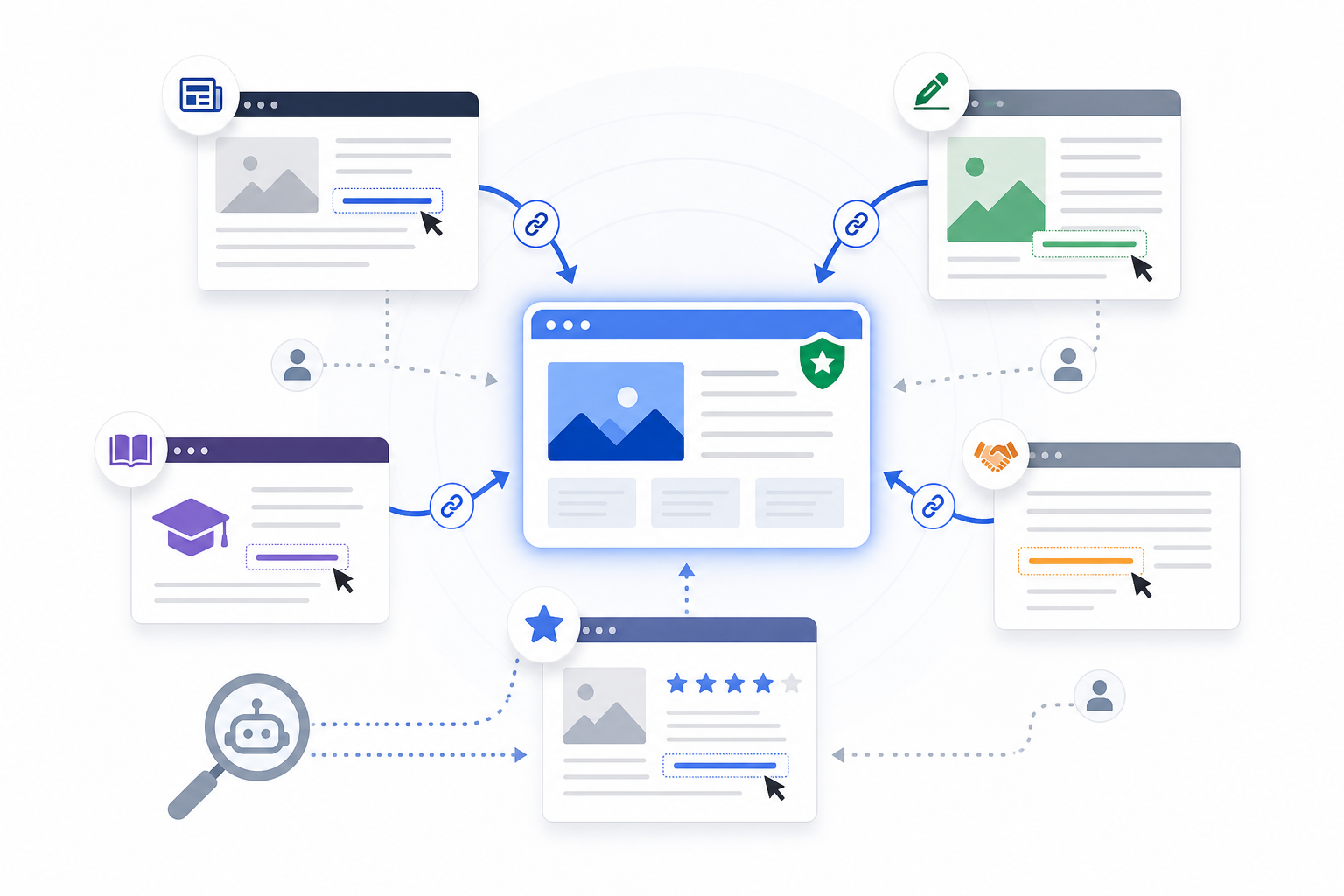
Backlinks are hyperlinks from pages on other websites that point to pages on the website being evaluated. A link from Website A to Website B is an outbound link for Website A and a backlink, also called an inbound link or incoming link, for Website B.
A backlink is therefore defined primarily by direction.
For example, if an article on website-a.com links to a guide on website-b.com, Website B receives the backlink. The same hyperlink is an external or outbound link from Website A’s perspective.
Backlinks operate between specific webpages rather than only between entire domains. A backlink normally contains:
- A source page, such as a news article, blog post, directory listing, or partner page.
- A clickable element, such as descriptive anchor text, a brand name, a URL, or a linked image.
- A destination page, such as a homepage, article, product page, service page, category page, research report, tool, or resource.
A backlink can therefore point directly to any useful URL on a website. It does not have to point to the homepage.
Text backlinks normally use anchor text. For example, the clickable phrase technical SEO guide can link from an external article to a technical SEO resource. Images, logos, buttons, and other valid clickable elements can also create backlinks when they link from one website to another.
Backlinks also function as navigation paths for users. A reader on an external publication can click a backlink and arrive directly at the destination page. This can create referral traffic, although not every backlink receives clicks.
Search engines can also encounter crawlable backlinks while processing webpages. An external link can expose a destination URL and provide contextual information through the source page, surrounding wording, anchor text, and destination. Discovery through a backlink does not guarantee that the destination will be crawled, indexed, or ranked.
Several backlink concepts should remain separate.
- Backlink does not mean ranking guarantee. An external link does not automatically improve rankings.
- Backlink does not mean quality. A backlink can be relevant, irrelevant, legitimate, artificial, useful, or low value.
- Backlink does not mean dofollow. A backlink can use standard, nofollow, sponsored, ugc, or other appropriate relationship treatment.
- Backlink does not mean editorial link. Editorial describes why a publisher chose to place a link; backlink describes its direction.
- Backlink does not mean link building. A backlink is the resulting hyperlink, while link building or backlinking describes activity used to develop external-reference opportunities.
The usefulness of an individual backlink depends on the complete relationship between the source and destination. Relevant attributes can include:
- Source legitimacy
- Source-page relevance
- Destination relevance
- Reference reason
- Audience
- Surrounding context
- Anchor wording
- Placement
- Acquisition circumstances
A backlink can exist for many legitimate reasons. Examples include citing research, attributing a source, recommending a product, providing evidence, identifying a company, documenting a partnership, referencing an expert, or directing readers to a useful resource.
Backlinks can also create value outside search rankings through outcomes such as referral traffic, public-relations visibility, citations, content discovery, product discovery, brand exposure, and business partnerships.
Backlinks are therefore external source-to-destination hyperlinks whose meaning and usefulness depend on why the external reference exists and how the source page relates to the destination.
What Are Backlinks in Digital Marketing?
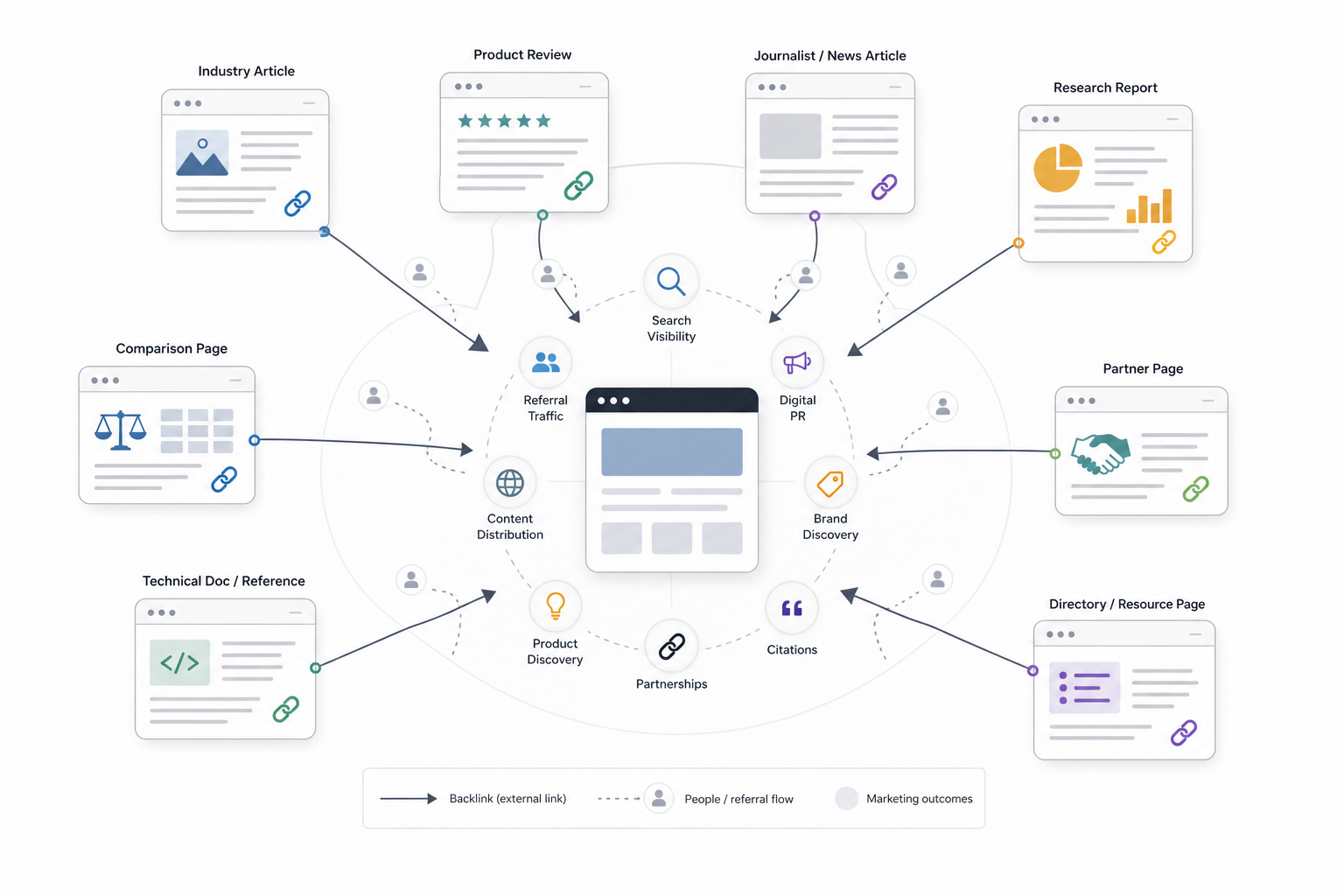
Backlinks in digital marketing are external hyperlinks that connect a third-party webpage with a company’s website and can support search visibility, referral traffic, content distribution, digital PR, brand discovery, product discovery, and business relationships. Their marketing value extends beyond SEO because a hyperlink can expose a business to both search systems and real external audiences.
Backlinks in SEO
Backlinks can contribute information to search systems about relationships between webpages.
A legitimate backlink can connect:
- An industry article with supporting research.
- A product review with the product being reviewed.
- A technical guide with official documentation.
- A partner page with the company it references.
The existence of the backlink does not guarantee higher rankings. Organic performance also depends on factors such as search intent, page relevance, content quality, technical accessibility, competition, and broader site context.
Backlinks and Referral Traffic
A backlink can send users directly from an external website to the destination.
For example:
A potential customer reads an industry article, clicks a company reference, visits the company’s website, and later submits an enquiry.
Referral traffic depends on attributes such as:
- Source audience
- Link visibility
- Placement
- Topic relevance
- User intent
A backlink can exist without receiving meaningful referral traffic.
Backlinks in Digital PR
Digital PR can create backlinks when journalists or publishers reference:
- Original research
- Company data
- Expert commentary
- Surveys
- Industry analysis
- Newsworthy company information
The backlink can provide source attribution while the wider PR coverage creates brand exposure.
A media mention without a hyperlink can still have PR value, but it is not technically a backlink.
Backlinks in Content Marketing
Content can earn external references when it gives other publishers something useful to cite or recommend.
Examples include:
- Original reports
- Statistics pages
- Templates
- Guides
- Calculators
- Data visualizations
- Technical resources
The backlink becomes one possible distribution outcome of the content rather than the sole reason the content exists.
Backlinks and Brand Discovery
A person can discover a company through an external reference before ever searching for its name.
For example, a SaaS buyer reading a comparison article can encounter a software brand for the first time through a product link.
This creates brand exposure even if the backlink’s direct ranking effect cannot be isolated.
Backlinks and Product Discovery
External pages can link directly to:
- Product pages
- Software pages
- Service pages
- Integration pages
- Category pages
A recommendation or comparison can therefore connect an external audience directly with the specific commercial resource being discussed.
Backlinks and Partnerships
Business relationships can naturally create external references.
Examples include:
- Technology integrations
- Authorized suppliers
- Distribution partners
- Industry associations
- Customer case studies
- Event partnerships
The underlying relationship should justify the reference independently of SEO.
Backlinks and Citations
A backlink can identify the original source of:
- A statistic
- A definition
- A methodology
- A research finding
- A technical specification
- A quotation
Citation links can improve source transparency for readers while creating external references for the cited website.
Backlinks and Audience Exposure
A backlink places a website, company, product, expert, or resource in front of an audience outside its own website.
This audience can come from:
- Media publications
- Industry websites
- Partners
- Directories
- Professional organizations
- Review sites
- Resource pages
The marketing value of that exposure depends on audience relevance rather than the existence of the backlink alone.
Backlinks therefore sit at the intersection of search, referral, PR, content, brand, product, and partnership marketing, while remaining technically defined as external hyperlinks pointing to the receiving website.
What Are Backlinks on a Website?
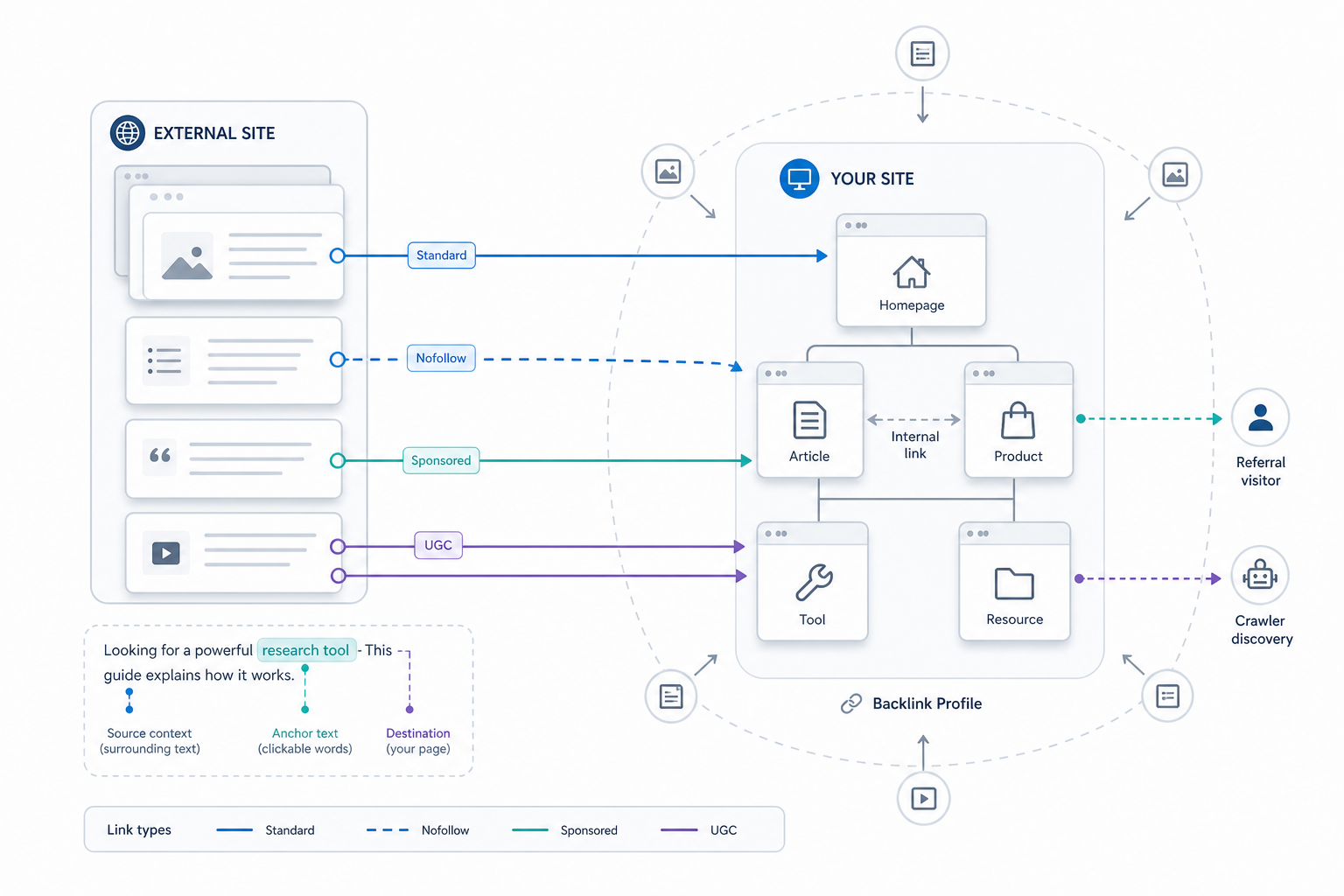
Backlinks on a website are hyperlinks from pages on other websites that point to pages on your own website. The link is outbound from the external source and inbound, or a backlink, from your website’s perspective.
Suppose Website A publishes an article and links to a guide on Website B.
For Website A, the link is outbound.
For Website B, the same hyperlink is a backlink.
Backlinks are also commonly called:
- Inbound links
- Incoming links
- External links pointing to your website
The term should not be confused with an internal link. An internal link connects two pages on the same website.
For example:
example.com/article-a linking to example.com/article-b is an internal link.
anotherwebsite.com/article linking to example.com/article-b is a backlink for example.com.
Which Pages Can Receive Backlinks?
Backlinks can point to any valid destination.
Common destinations include:
- Homepage
- Blog article
- Product page
- Service page
- Category page
- Tool
- Research page
- Landing page
- Resource
A backlink therefore exists at the URL level first, even though SEOs also analyze backlinks across an entire domain.
Can One Website Have Multiple Backlinks From the Same Domain?
Yes.
One external domain can link to several pages on your website or link repeatedly to the same page.
For example, an industry publication can link to:
- Your annual research report from one article.
- Your calculator from another article.
- Your company homepage from an author profile.
These represent separate backlinks even though they come from the same referring domain.
What Is a Website’s Backlink Profile?
A website’s backlink profile is the combined collection and characteristics of external links pointing to its pages.
The profile can include information such as:
- Referring pages
- Referring domains
- Target pages
- Anchor text
- Link attributes
- New links
- Lost links
The complete backlink-profile concept is discussed separately below.
How Can Backlinks Send Visitors to Your Website?
A person on the external website can click the hyperlink and visit your page.
The resulting session can be classified as referral traffic depending on the analytics implementation and navigation context.
Whether meaningful referral traffic occurs depends on factors such as:
- Audience relevance
- Placement visibility
- Page traffic
- Reader interest
- Link context
Can Backlinks Help Search Engines Discover Pages?
Yes. A crawlable backlink can provide a path through which a search engine discovers a destination URL.
The process should not be simplified into “backlink equals indexation.”
A URL can be:
- Discovered
- Crawled
- Rendered where necessary
- Evaluated for indexing
- Considered for rankings
Each stage is distinct.
What Context Does a Backlink Contain?
A backlink connects several pieces of information.
These can include:
- Source-page topic
- Anchor text
- Surrounding sentence
- Destination page
- Reason for the reference
Search systems can evaluate these relationships rather than treating every external hyperlink identically.
Are All Backlinks Equally Useful?
No.
Backlink usefulness can depend on:
- Source legitimacy
- Source-page relevance
- Destination relevance
- Reference reason
- Audience fit
- Surrounding context
- Placement
- Anchor wording
- Relationship behind the link
Raw backlink count does not describe these characteristics.
Does Relevance Require the Same Niche?
No.
Relevance can arise from several relationships.
Examples include:
- Topic relevance
- Entity relationship
- Product use case
- Research citation
- Geographic relevance
- Audience relevance
- Partnership
- Business relationship
A general publication can contain a highly relevant page about a specialized topic, while a niche website can contain an unrelated page.
Can Backlinks Be Nofollow?
Yes.
Backlink describes direction.
Values such as standard, nofollow, sponsored, and ugc describe relationship treatment.
An external website can therefore give your site:
- A standard backlink
- A nofollow backlink
- A sponsored backlink
- A UGC backlink
Follow status does not define whether the hyperlink is technically a backlink.
Is a Dofollow Backlink Always Editorial?
No.
Editorial status and link treatment are separate attributes.
Examples include:
- Editorial + standard backlink
- Editorial + nofollow backlink
- Sponsored + qualified backlink
A standard link can also be manipulative, while a nofollow backlink can be legitimate and useful.
Why Might Another Website Link to Yours?
Common reference reasons include:
- Citation of research
- Product recommendation
- Attribution
- Supporting evidence
- Source reference
- Partnership
- Resource inclusion
- Company identification
- Expert quote
- Tool recommendation
One destination can also receive links for different reasons.
For example, a research report can receive:
- A citation from a journalist
- A reference from an industry blogger
- A link from a professional association
- A mention from a business partner
Can Backlinks Use Different Anchor Text?
Yes.
External publishers can link through wording such as:
- Page title
- Brand name
- Descriptive phrase
- Product name
- Related term
- URL
- Generic wording
The anchor is one characteristic of the backlink rather than its definition.
Can an Image Be a Backlink?
Yes.
If an image on one website is clickable and points to another website, the receiving site has a backlink even though there is no ordinary visible text anchor.
Is a Brand Mention a Backlink?
Not necessarily.
“ExampleCo” written as plain text is a brand mention.
“ExampleCo” containing a clickable link to example.com is a backlink for ExampleCo.
Likewise, a plain-text URL that is not clickable is not necessarily a hyperlink.
Backlinks to your website can therefore support four broad outcomes:
Search discovery: They can expose destination URLs.
Search context: They connect external source content with destination pages.
Referral traffic: They can send users directly to the website.
External recognition: They can expose content, products, brands, experts, or research through third-party references.
What Is a Backlink Example?
A backlink example is a clickable link placed on one website that points to a page on another website. The hyperlink is outbound for the website containing it and a backlink for the website receiving it.
Consider this simple example.
Source: A fitness blog
Sentence: “Use this marathon training plan before your first race.”
Anchor: marathon training plan
Destination: A marathon-training guide on another website
The fitness blog contains an outbound link.
The website hosting the marathon guide receives a backlink.
Editorial Backlink Example
Source: News article about regional food trends
Anchor: traditional Gujarati recipes
Destination: Original recipe guide on another website
The news article externally references the recipe resource because it supports the subject being discussed.
From the destination website’s perspective, that link is a backlink.
Guest Contribution Backlink Example
Source: Relevant industry publication
Context: An expert contributes a useful article and references a supporting resource where editorially appropriate
Anchor: conversion rate optimization checklist
Destination: Checklist on the expert’s company website
The company receives a backlink because an external publication links to its resource.
The backlink should serve the article rather than exist only because the author wanted an SEO link.
Directory Backlink Example
Source: Legitimate local business directory
Clickable element: Business name
Destination: Business homepage
The business homepage receives a backlink because another domain contains a clickable link to it.
Whether the directory is useful or low quality depends on the actual directory and its purpose.
Resource Page Backlink Example
Source: University resource page
Anchor: free compound interest calculator
Destination: Calculator on another website
The university page references the tool because it is relevant to its resource collection.
Research Citation Backlink Example
Source: Marketing publication
Context: The author uses an industry statistic
Anchor: 2026 SaaS retention study
Destination: Original research report
The research website receives a backlink because the publisher cites the source of its evidence.
Product Recommendation Backlink Example
Source: “Best Project Management Tools” article
Anchor: Product name
Destination: Product homepage or product page
The external article links readers directly to the software being discussed.
The basic backlink relationship remains the same whether the recommendation is editorial, affiliate, or sponsored, although the commercial relationship can affect link qualification.
Partner Backlink Example
Source: Technology partner page
Anchor: Integration or company name
Destination: Partner website or integration page
The backlink reflects an existing business relationship between the organizations.
What Does a Backlink Look Like in HTML?
A simple backlink can appear as:
<a href="https://website-b.com/guide">helpful guide</a>
If this code exists on Website A:
- Website A contains the source link.
- https://website-b.com/guide is the destination.
- “helpful guide” is the anchor text.
- Website B receives the backlink.
Can a Nofollow Link Still Be a Backlink?
Yes.
If an external website points to your page through a nofollow link, your website still receives a backlink.
“Nofollow” describes relationship treatment.
“Backlink” describes direction.
The same applies to sponsored and UGC links.
Every backlink example therefore contains the same central structure: one website contains a hyperlink that points to a page on another website.
How Do Backlinks Work?
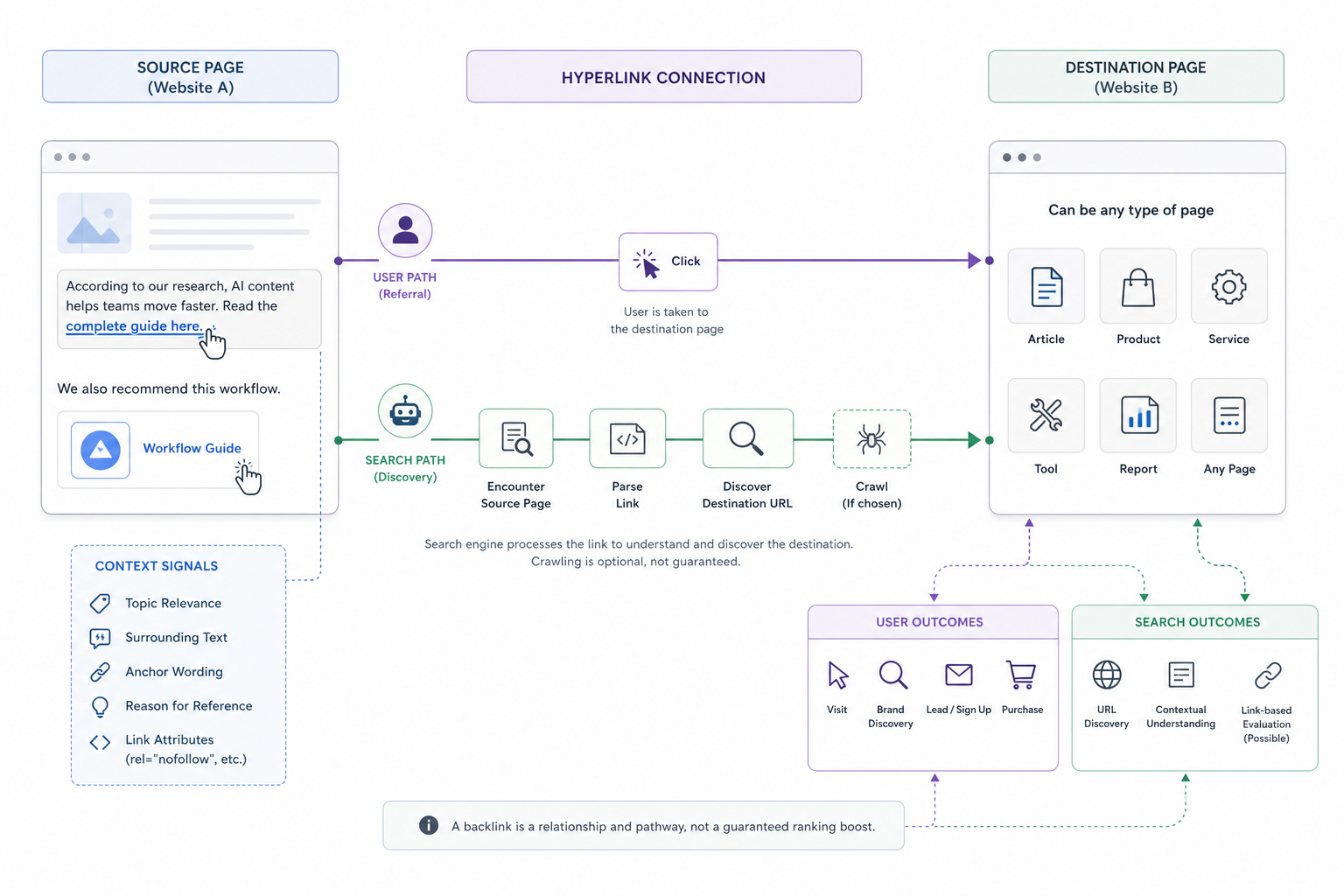
Backlinks work by creating a hyperlink from a source page on one website to a destination page on another website, allowing users and search systems to encounter and interpret the relationship between those two pages. A backlink can create navigation, discovery, contextual, and link-based information without guaranteeing any search outcome.
1. An External Publisher Creates the Hyperlink
Website A links to Website B.
For Website A, the link is outbound.
For Website B, the same hyperlink is a backlink.
2. The Backlink Has a Source and Destination
Every backlink connects two URLs.
Source page: The external page containing the link.
Destination page: The URL receiving the backlink.
The destination can be a homepage, product page, article, service, research report, tool, or another resource.
3. The Link Uses a Clickable Element
Text links commonly contain anchor text.
For example:
“See this technical SEO guide.”
Images, logos, buttons, and other clickable elements can also create hyperlinks.
4. Source Context Gives the Link Meaning
The relationship can be interpreted through attributes such as:
- Source-page topic
- Surrounding sentence
- Anchor text
- Destination content
- Reason for the reference
A citation to a scientific study represents a different relationship from an unrelated directory placement.
5. Users Can Follow the Link
A person reading the source page can click the backlink and visit the destination.
This can create referral traffic.
Referral traffic is a user outcome rather than a guaranteed characteristic of every backlink.
6. A Search Engine Can Encounter the Source Page
For a search system to process the link from that page, it first needs to access or otherwise encounter the source.
7. The Hyperlink Can Be Parsed
A search system can identify information such as:
- Destination
- Anchor text or clickable element
- Relevant link attributes
- Surrounding source content
Parsing the hyperlink does not establish how much value, if any, the search system assigns to it.
8. The Destination Can Be Discovered
A crawlable backlink can expose the destination URL.
Discovery is only one stage.
Discovery does not equal crawling, indexing, or ranking.
9. The Destination May Be Crawled
Search systems can decide whether and when to crawl a discovered URL.
A backlink creates a possible path.
It does not command a crawler to fetch the destination.
10. Source-to-Destination Context Can Be Interpreted
The relationship can contain several signals, including:
- Source topic
- Anchor wording
- Surrounding text
- Destination
- Link qualification
The complete context is more informative than follow status alone.
11. Relevance Can Be Evaluated
The relationship can make sense through several forms of relevance.
Examples include:
- Topic
- Citation
- Evidence
- Entity
- Product
- Business relationship
- Attribution
Relevance does not require two domains to belong to exactly the same niche.
12. Link-Based Systems May Evaluate the Relationship
Legitimate backlinks can potentially contribute information to systems that analyze relationships among webpages.
This should not be translated into a fixed amount of “authority” passing through every link.
Search systems do not need to treat every backlink identically.
13. User and Search Outcomes May Follow
Possible user outcomes include:
- Referral visit
- Product discovery
- Brand discovery
- Lead
- Purchase
Possible search outcomes include:
- URL discovery
- Contextual understanding
- Potential contribution within broader link-based systems
These outcomes remain separate.
The mechanism should therefore be understood as source page, hyperlink, destination, user navigation, search discovery, contextual interpretation, and possible downstream outcomes, not simply “backlink equals ranking boost.”
What Is a Backlink Profile?
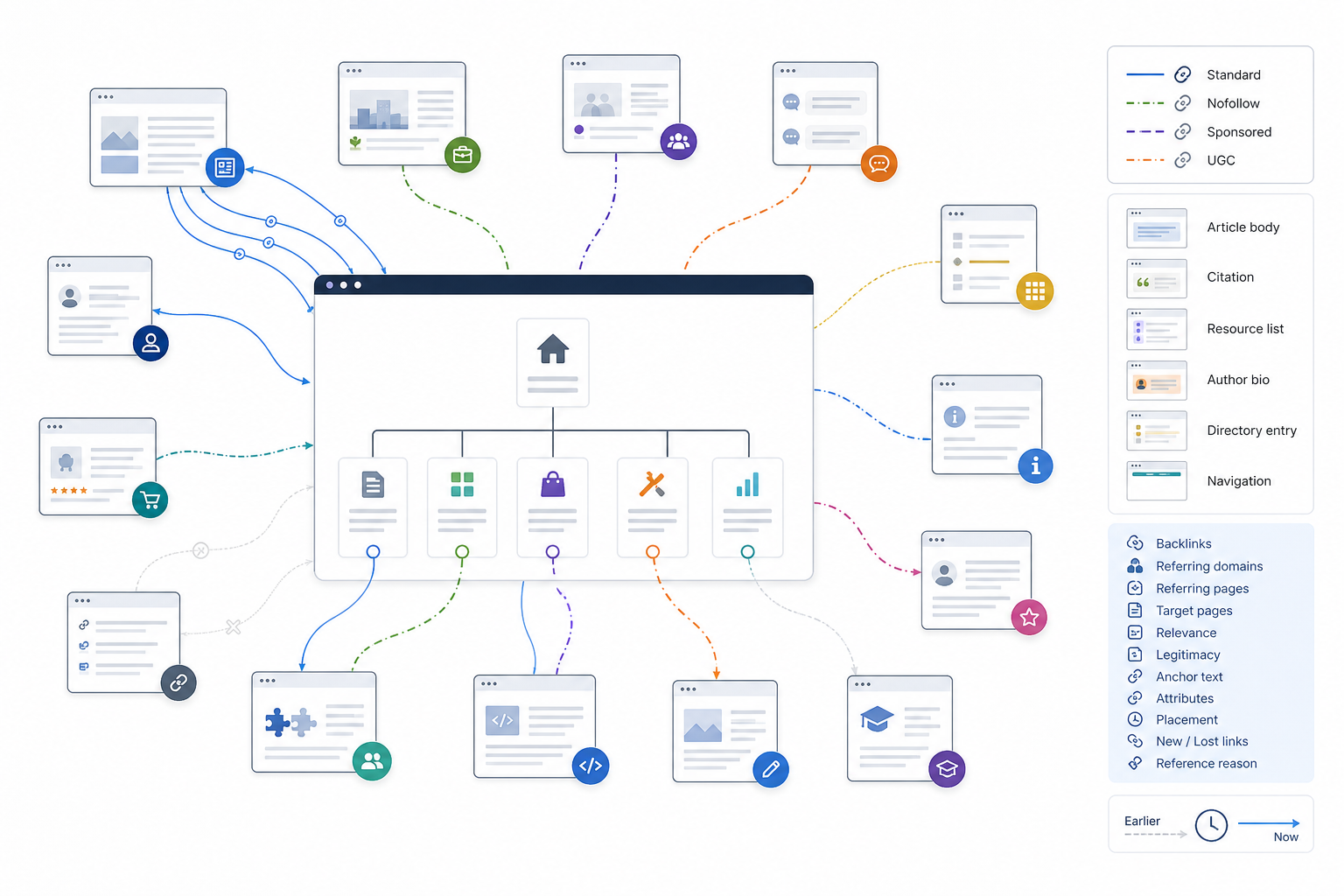
A backlink profile is the aggregate collection and characteristics of external links pointing to a website, domain, section, or individual page. One external hyperlink is a backlink; the combined set of backlinks and their characteristics forms the backlink profile.
A backlink profile is not one number.
It contains several attributes.
| Backlink Profile Attribute | What It Shows | What to Evaluate | What Not to Assume |
|---|---|---|---|
| Backlinks | Individual incoming hyperlinks | Source, destination, context | More automatically means better |
| Referring Domains | Distinct linking websites | Legitimacy and relevance | More domains automatically improve SEO |
| Referring Pages | Individual source URLs | Page-level context | Every page on one domain has equal value |
| Target Pages | URLs receiving links | What assets attract references | Links should be evenly distributed |
| Relevance | Source-to-destination relationship | Topic, audience, entity, reason | Same niche is always required |
| Anchor Text | Clickable wording used externally | Context and accuracy | A fixed ratio is required |
| Link Attributes | Standard, nofollow, sponsored, UGC | Whether treatment fits relationship | Follow status equals quality |
| Placement | Where links appear | Purpose and user context | Body links always outperform every other placement |
| New / Lost Links | Changes over time | Why links appeared or disappeared | Growth is always positive or loss always harmful |
| Reference Reason | Why the source links | Citation, recommendation, partnership, evidence | Metrics can replace contextual evaluation |
Backlink Count
Backlink count measures individual external hyperlinks.
A website can receive many links from one external domain.
Raw count describes volume rather than relevance, legitimacy, or usefulness.
Referring Domains
Referring domains count distinct websites providing backlinks.
For example:
100 backlinks from example.com represent 100 backlinks but one referring domain.
Referring-domain count can describe breadth, but it should not become an isolated target.
Referring Pages
Different pages on the same domain can have different:
- Topics
- Audiences
- Placements
- Contexts
- Reference reasons
Page-level evaluation therefore remains important.
Target Pages
A backlink profile also shows which URLs receive external references.
Examples include:
- Homepage
- Category pages
- Product pages
- Service pages
- Blog articles
- Tools
- Research pages
A research report can naturally attract more links than a checkout page. Backlinks do not need to be evenly distributed across a website.
Source-to-Destination Relevance
Useful relevance can come through relationships such as:
- Subject matter
- Citation
- Entity
- Product
- Industry
- Location
- Partnership
- Audience need
A linking website does not need to operate in exactly the same niche.
Source Legitimacy
A backlink profile can contain links from:
- Publications
- Businesses
- Organizations
- Communities
- Directories
- Partners
- Artificial sites
Source legitimacy should be evaluated separately from third-party authority metrics.
A smaller specialist website can provide a highly meaningful reference, while a high-metric domain can contain an irrelevant placement.
Reference Reason
One of the most useful questions in backlink analysis is: Why does this link exist?
Legitimate reasons include:
- Citation
- Attribution
- Evidence
- Recommendation
- Partnership
- Product reference
- Integration
- Resource inclusion
- Further reading
Understanding the reference reason provides information that raw metrics cannot.
Anchor Text
A backlink profile can contain anchors such as:
- Brand names
- Exact topic wording
- Descriptive phrases
- Related terms
- URLs
- Generic wording
- Image links
Different external sources naturally choose different wording.
Anchor distribution should be observed rather than engineered toward one universal percentage formula.
Link Attributes
Backlinks can use relationship treatments such as:
- Standard
- nofollow
- sponsored
- ugc
A backlink profile does not need a predetermined percentage of each.
The appropriate treatment depends on the underlying relationship.
Follow Status and Quality
Follow status does not determine backlink quality.
A standard backlink can be manipulative.
A nofollow or sponsored link can be legitimate and commercially useful.
Placement
Backlinks can appear in several contexts.
Examples include:
- Article body
- Citation
- Resource list
- Author information
- Directory
- Partner page
- Product listing
- Navigation
Placement should be interpreted together with why the link exists and how users encounter it.
Reference Context
A backlink profile can contain links generated through:
- Editorial citations
- Digital PR
- Resource pages
- Partnerships
- Directories
- Guest contributions
- Product references
- Research citations
- Integrations
- Associations
Acquisition context and link treatment are different dimensions.
An editorial link can be nofollow.
A directory link is not automatically low quality.
A sponsored link is not automatically spam.
New Links
Backlink tools can report newly discovered external references.
A rise in new links can result from:
- PR coverage
- Product launches
- New research
- Partnerships
- Normal publishing activity
- Artificial activity
An increase alone does not establish whether the change is positive.
Lost Links
Backlinks can disappear because:
- Source content was removed
- Destination changed
- Publisher edited the page
- Page was redirected
- Partnership ended
- Resource became outdated
Not every lost link needs to be recovered.
Link Growth Over Time
A backlink profile has a historical dimension.
Rapid increases are not automatically suspicious. A successful research launch, major product announcement, or widespread media campaign can legitimately generate many new links in a short period.
There is no universal “safe link velocity.”
Geographic and Language Context
A website can receive links from different countries and languages because of:
- International customers
- Media coverage
- Partnerships
- Research citations
- Global operations
A foreign-language backlink should not be classified as harmful solely because of its language.
Domain-Level and Page-Level Profiles
Backlink profile can describe different scopes.
Domain-level profile: External links pointing across the website.
URL-level profile: Links pointing to one page.
Subfolder or subdomain profile: Links associated with one defined website section where the analysis tool supports that scope.
Comparisons should use equivalent scopes.
Backlink Profiles and Third-Party Authority Metrics
Metrics such as:
- Domain Rating
- Domain Authority
- Authority Score
are third-party measurements.
They can support comparative research but are not Google metrics and do not replace the underlying backlink data.
There is no universal rule such as “DR 50+ equals a good backlink” or “DA below 20 equals a bad backlink.”
What Can a Strong Backlink Profile Look Like?
A useful backlink profile can contain many links where:
- Sources are legitimate.
- Source and destination relationships make sense.
- Reference reasons are identifiable.
- Destination pages are genuinely useful.
- Anchor wording reflects source context.
- Link treatment reflects the actual relationship.
- References align with real editorial, PR, product, or business activity.
This is a qualitative description rather than a formula.
What Can a Problematic Backlink Profile Contain?
Patterns worth reviewing can include:
- Large amounts of automated backlinks
- Artificial website networks
- Paid links intended primarily to manipulate rankings
- Excessive reciprocal arrangements
- Irrelevant mass-directory submissions
- Repeated controlled commercial anchor text
- Links with no plausible audience or reference reason
These are investigation patterns, not proof that every individual link causes a penalty.
A backlink profile is therefore not simply the number of backlinks a site has; it is the combined footprint of who links, where the links appear, which pages they target, why they exist, how they are worded and qualified, and how those relationships change over time.
Do Backlinks Help SEO?
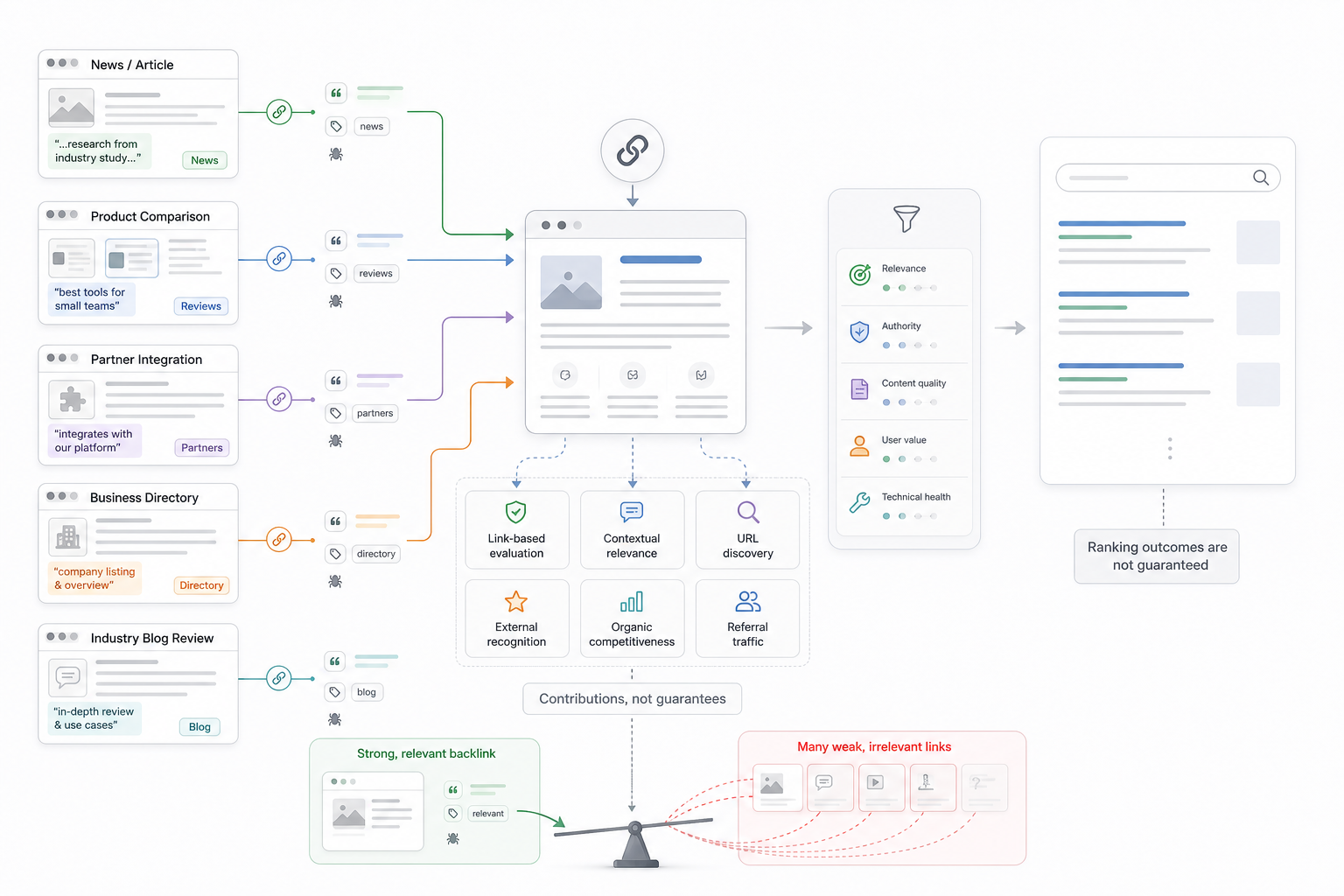
Yes. Backlinks can help SEO when they create legitimate and relevant external relationships, but backlinks are only one input within broader search systems and do not guarantee rankings. Their potential contribution includes link-based evaluation, contextual relationships, URL discovery, organic competitiveness, and external recognition.
1. Backlinks Can Contribute to Link-Based Search Evaluation
Search systems can use relationships among webpages as one source of information.
A relevant external backlink can therefore potentially contribute link-based information.
This should not be interpreted as a guaranteed or measurable amount of authority being transferred through every link.
2. Backlinks Connect Pages Contextually
A backlink explicitly connects an external source with a destination.
Relevant information can come from:
- Source topic
- Anchor text
- Surrounding content
- Destination page
- Reference reason
This gives search systems additional relationship context.
3. Backlinks Can Help With URL Discovery
A crawlable external backlink can expose a destination URL.
A search engine can discover a page through:
- Backlinks
- Internal links
- Sitemaps
- Previously known URLs
- Other discovery mechanisms
Discovery does not guarantee indexing.
4. Backlinks Can Support Organic Competitiveness
Where several webpages satisfy a query well, external references can become one component of the competitive environment surrounding those pages.
The relationship remains conditional.
A backlink does not automatically produce a ranking increase.
5. Backlinks Can Create External Recognition
Independent external websites can reference:
- Research
- Products
- Tools
- Brands
- Experts
- Content
These references show where a website or entity is being mentioned or cited across the web.
External recognition should not automatically be translated into a literal “Google trust” score.
6. Backlinks Can Generate Referral Traffic
Users can click backlinks directly.
For example, a buyer can discover a SaaS product through a comparison article and click through to the product website.
Referral value is separate from ranking impact.
Why Does Backlink Relevance Matter?
A backlink has a clearer contextual relationship when the source has a logical reason to reference the destination.
Relevance can arise through:
- Topic
- Evidence
- Citation
- Entity
- Product
- Audience
- Industry
- Location
- Partnership
This relationship is more specific than simply comparing the categories of two domains.
Why Does Legitimacy Matter?
A useful backlink normally has a plausible reason to exist.
For example:
A journalist cites original research.
A partner links to a real integration.
A product review references the product being evaluated.
A directory lists a genuine business.
The reason for the link helps explain the relationship.
Does More Backlinks Mean Better SEO?
Not necessarily.
Raw backlink count does not establish:
- Relevance
- Legitimacy
- Usefulness
- Context
- Audience value
A website can have many weak or artificial links.
Another website can have fewer links but stronger contextual external references.
This does not mean one relevant backlink is always mathematically better than a fixed number of weaker links. Link evaluation cannot be reduced to a universal conversion formula.
Do High DR or DA Backlinks Help More?
Not automatically.
Domain Rating, Domain Authority, Authority Score, and similar metrics can support research.
They are not Google's definition of backlink value.
A useful backlink should still be evaluated through the actual source page, destination, context, audience, and reference reason.
Are Backlinks Equally Important for Every Query?
No.
Their relative importance can differ according to:
- Competition
- Query
- Topic
- Search intent
- Destination quality
- Existing external references
- Brand recognition
- Wider search environment
There is no reliable universal percentage stating how much of SEO performance comes from backlinks.
Does Anchor Text Determine Backlink Value?
No.
Anchor text can provide contextual information, but it is one characteristic of the complete relationship.
Similarly:
- Follow status describes treatment.
- Placement describes where the link appears.
- Reference reason explains why the link exists.
None of these dimensions independently determines the search impact of a backlink.
Backlinks can therefore support SEO through discovery, contextual page relationships, external recognition, and possible link-based search evaluation, but their effects depend on the wider source-to-destination relationship and the complete search environment. These outcomes explain the broader link building benefits, which can extend beyond rankings to referral traffic, brand exposure, content discovery, and external recognition.
What Is Backlinking?
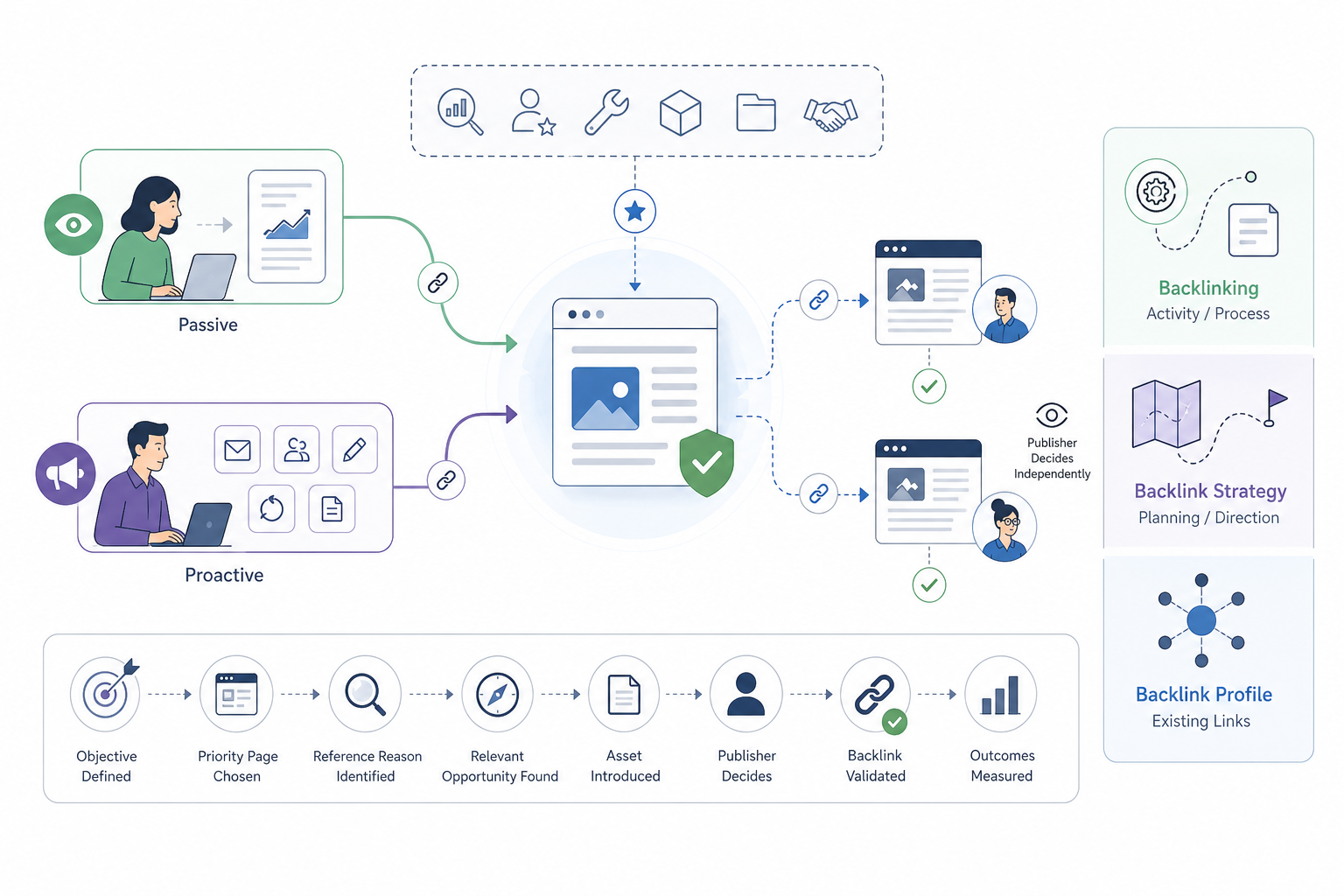
Backlinking is the deliberate activity of earning, developing, or acquiring external references from other websites to relevant pages on your own website. The backlink is the resulting hyperlink; backlinking is the process used to create legitimate opportunities for those external references.
Backlinking should not mean creating links everywhere possible.
A legitimate process begins with a reason another website might want to reference the destination.
Examples include:
- Useful evidence
- Original research
- Expert knowledge
- A relevant product
- A practical tool
- A business relationship
- A useful resource
The reference reason comes before the placement.
Passive Backlink Acquisition
Passive acquisition occurs when an external publisher independently discovers a resource and links to it.
For example:
A journalist finds an original study through search and cites it.
No direct outreach was required.
Proactive Backlink Acquisition
Proactive backlinking involves increasing the visibility of something worth referencing.
Activities can include:
- Digital PR
- Relevant outreach
- Expert contributions
- Partnership development
- Resource promotion
- Link reclamation
- Relationship development
Proactive promotion does not automatically make a backlink artificial.
The external publisher can still independently decide whether and how to link.
What Is the Basic Backlinking Process?
At a high level, backlinking involves:
- Identifying a business or SEO need.
- Determining why an external source could legitimately reference the destination.
- Finding a relevant opportunity.
- Introducing or exposing the asset, expertise, product, or relationship.
- Allowing the external publisher to decide whether a reference belongs.
- Validating the resulting backlink.
- Measuring relevant outcomes.
Backlinking should therefore be centered on external reference opportunities rather than backlink volume.
What Activities Can Backlinking Include?
Legitimate activities can include:
- Making useful assets discoverable
- Digital PR
- Expert contributions
- Relevant outreach
- Partnerships
- Reclamation
- Resource promotion
- Relationship development
These are examples rather than requirements for every campaign.
Does Backlinking Mean Buying Links?
No.
Paid, sponsored, affiliate, advertising, or otherwise compensated relationships can exist, but they can require appropriate disclosure or relationship qualification.
Backlinking should not be defined as purchasing ranking-influencing links.
Is Backlinking the Same as Link Building?
The terms are often used similarly within SEO.
Both can describe deliberate activity designed to develop relevant external references.
The useful conceptual distinction is not the wording but whether the activity creates legitimate reference opportunities rather than manufactured backlink counts.
How Is Backlinking Different From a Backlink Profile?
Backlinking describes activity.
Backlink profile describes the existing aggregate result of external links pointing to the target.
How Is Backlinking Different From a Backlink Strategy?
Backlinking is the broader acquisition activity.
Backlink strategy is the planning system used to decide what should be pursued, why, and how.
How Is Backlinking Different From a Backlink Source?
Backlinking describes the activity.
A backlink source is the publication, website, organization, platform, community, or business relationship from which a reference opportunity can originate.
Backlinking is therefore the broader process of developing legitimate external references, while the strategy determines how that activity should be organized.
What Is a Backlink Strategy?
A backlink strategy is the structured plan used to decide which external references a website needs, which pages should be supported, why relevant sources might genuinely link, how opportunities should be pursued, and how results should be measured. It organizes backlinking around objectives and reference reasons rather than isolated tactics or fixed link quotas. Within a broader search engine optimization strategy, backlink planning should support the pages and search priorities that need stronger external references rather than operate as a separate link-acquisition exercise.
1. Define the Objective
Possible objectives include:
- Supporting priority pages
- Promoting original research
- Increasing external visibility
- Generating referral traffic
- Increasing industry exposure
- Strengthening external recognition
Do not begin with a backlink quota such as “we need 30 links this month” without first defining why those external references are needed.
2. Identify Priority Pages
Determine which URLs matter to the business or search strategy.
Examples include:
- Product pages
- Service pages
- Categories
- Research
- Tools
- Guides
Then evaluate whether those pages provide something an external source could reasonably reference.
3. Review the Existing Backlink Profile
Understand attributes such as:
- Existing external references
- Frequently linked pages
- Lost links
- Weakly supported priority pages
- Current business relationships
Use this as strategic input rather than repeating the entire backlink-profile analysis.
4. Review Competitor Reference Patterns
Study why relevant competing pages receive external links.
Look for patterns involving:
- Research
- Tools
- Citations
- Business relationships
- Publishers
- Resources
Do not mechanically copy competitor referring URLs.
5. Identify the Reference Reason
Ask:
Why should another website genuinely reference this page?
Possible answers include:
- Evidence
- Research
- Statistics
- Expertise
- Useful resource
- Tool
- Product
- Partnership
- Attribution
A reference reason should exist before prospecting begins.
6. Create or Improve the Referenceable Asset When Needed
A page can require stronger:
- Evidence
- Data
- Functionality
- Information
- Case studies
- Expert input
Create improvements because they make the resource more useful, not simply because backlinks are required.
7. Select the Appropriate Acquisition Approach
The reference reason should influence the method.
For example:
Original data can fit digital PR or research outreach.
A product integration can fit partner outreach.
A missing citation can fit reclamation.
A useful tool can fit resource promotion.
Not every tactic fits every page.
8. Map Relevant Source Families
Identify the types of sources that could realistically need the resource.
Examples include:
- Journalists
- Industry publishers
- Partners
- Resource pages
- Associations
- Relevant directories
The next section examines these source categories in detail.
9. Prioritize Opportunities
Evaluate potential opportunities using attributes such as:
- Relevance
- Source legitimacy
- Audience
- Destination fit
- Reference reason
- Realistic opportunity
Do not prioritize solely by DR, DA, or another third-party metric.
10. Develop the Communication or Distribution Approach
The resource can be introduced through:
- Outreach
- PR
- Relationship communication
- Expert contribution
- Promotion
The approach should match the opportunity.
11. Preserve External Discretion
External publishers, journalists, partners, or organizations should retain meaningful control over whether and how they reference the destination.
A legitimate backlink strategy does not require controlling every external placement.
12. Validate Resulting Backlinks
Review:
- Source
- Destination
- Context
- Anchor
- Relationship treatment
- Reference reason
A backlink is not automatically useful merely because the campaign succeeded in getting it published.
13. Measure Campaign Outputs
Possible outputs include:
- Backlinks
- Referring sources
- Media mentions
- Citations
- Referral visits
- Supported pages
These describe what the campaign produced directly.
14. Measure Broader Outcomes
Where relevant, review:
- Search visibility
- Referral traffic
- Leads
- Sales
- Brand exposure
Avoid attributing every downstream movement to one backlink without evidence.
15. Refine the Strategy
Document which:
- Assets
- Reference reasons
- Source families
- Acquisition approaches
- Relationships
produce useful results.
Use those findings to improve future campaigns.
A backlink strategy is not the same as:
- One backlink tactic
- One publisher
- An outreach template
- A backlink profile
- A fixed monthly quota
It is the planning framework that turns business and SEO needs into a structured approach for developing relevant external references.
Where Can You Get Backlinks for SEO?
SEO backlinks can come from relevant publishers, media outlets, industry resources, business relationships, directories, communities, and other websites that have a legitimate reason to reference your brand, expertise, product, research, or content. The correct starting point is not “Which website will give me a backlink?” but “Which type of source genuinely needs what this page provides?”
Backlink sources can be grouped into five broad families.
| Backlink Source Family | Examples | Why a Link May Exist |
|---|---|---|
| Editorial / Media | Journalists, news publications, trade media, expert-source platforms | Evidence, expertise, news, research |
| Resource / Content | Blogs, resource pages, research articles, statistics pages | Useful information, data, tools |
| Business Relationships | Partners, integrations, customers, suppliers, associations | Real organizational or commercial relationship |
| Discovery / Listings | Review platforms, relevant directories, local listings, marketplaces | Entity or product discovery |
| Community / Distribution | Podcasts, professional communities, forums, social platforms | Expertise, contribution, discovery |
Journalists and Media Publications
Journalists, editors, and publishers can reference:
- Experts
- Original research
- Company data
- Case studies
- Statistics
- Products
- Commentary
when those elements help complete a story.
Relevant sources can include:
- News publications
- Trade media
- Industry magazines
- Specialist blogs
- Newsletters
- Podcasts with show notes
- Editorial websites
The strongest opportunity exists when the source needs information you can genuinely provide.
Journalist-Source Platforms
Platforms connecting journalists with experts can surface media opportunities.
For example, an expert-source platform can connect:
- Journalist request
- Relevant specialist
- Expert response
- Publisher selection
- Possible citation or mention
A successful expert contribution does not guarantee a backlink. The publisher controls whether it links and how the relationship is treated.
Industry Publications
Industry publications can reference:
- Research
- Experts
- Tools
- Products
- Technical documentation
- Case studies
- Market data
because those resources are relevant to their professional audience.
A smaller specialist publication can sometimes provide a more relevant reference than a large general website.
Resource Pages
Resource pages can link to:
- Tools
- Calculators
- Templates
- Guides
- Research
- Databases
- Educational resources
when those resources genuinely improve the collection.
The page should have a real curatorial or educational purpose rather than exist mainly for link exchanges.
Research Citations
Writers and researchers can cite:
- Surveys
- Statistics
- Datasets
- Experiments
- Benchmarks
- Methodologies
The original source is generally the most appropriate destination where available.
Review and Comparison Platforms
Product and service platforms can reference:
- Software
- Products
- Providers
- Local businesses
The resulting link can support product discovery or referral traffic even where link treatment is qualified.
The business value should remain separate from assumptions about ranking value.
Relevant Directories
Legitimate directories can provide useful backlinks when users genuinely use them to discover:
- Businesses
- Professionals
- Products
- Suppliers
- Services
Examples include:
- Industry directories
- Professional directories
- Local business directories
- Partner directories
Mass submission to unrelated low-quality directories is a different practice.
Partners and Integrations
Real business relationships can create natural reference opportunities.
Examples include:
- Technology partners
- SaaS integrations
- Suppliers
- Distributors
- Customers
- Agencies
- Channel partners
A public reference should help users understand the underlying relationship.
Associations and Professional Organizations
Associations can reference genuine members through:
- Member directories
- Accreditation pages
- Certification records
- Industry resources
- Professional profiles
Membership should have independent business or professional value.
Events and Conferences
Participation can create references through:
- Speaker profiles
- Exhibitor pages
- Sponsor pages
- Event resources
- Webinar pages
- Conference listings
The event relationship should be genuine.
Podcasts and Interviews
Experts, executives, founders, practitioners, or researchers can receive links through:
- Show notes
- Guest profiles
- Episode descriptions
- Supporting resources
The primary value should be the expert contribution to the audience.
Product Communities
Products can gain exposure through relevant technology or professional communities.
Examples can include:
- Product-discovery communities
- Developer ecosystems
- Software marketplaces
- Specialist community sites
These environments can generate direct links, mentions, audience exposure, or later editorial discovery.
Publishing Platforms
Platforms that allow businesses or experts to publish content can support:
- Audience reach
- Content distribution
- Thought leadership
- Brand discovery
Creating duplicate low-value posts simply to place backlinks is different from genuine publishing.
Communities and Forums
Community participation can occasionally include useful links when the resource genuinely answers a user’s question.
For example:
A developer answering an implementation problem can link to official documentation that solves it.
Keyword-rich forum comments, signatures, or repetitive links created mainly for SEO do not provide the same legitimate reference reason.
Social Platforms
Social platforms can distribute:
- Research
- Tools
- Articles
- Product announcements
- Expert commentary
A social link itself should not automatically be treated as equivalent to an independent editorial backlink.
Its value can instead come through distribution and discovery. A journalist can discover a study on LinkedIn and later cite the original research from a publication.
Competitor Backlink Sources
Competitor research can reveal:
- Publisher categories
- Citation needs
- Resource pages
- Review platforms
- Partnerships
- Content formats attracting references
The useful question is:
Why does this competitor backlink exist, and does the same reference need legitimately apply to us?
Do not ask every competitor referring domain for the same placement.
Search Results
Manual search can identify sources already publishing around relevant topics.
Examples include:
- Resource pages
- Statistics articles
- Recommended-tool lists
- Industry roundups
- Expert interviews
- Association pages
- Relevant publications
Appearing in search results does not create a reason for a publisher to link. It only helps identify possible prospects.
Existing Business Relationships
Some of the strongest opportunities can already exist within a company’s business network.
Review relationships involving:
- Clients
- Suppliers
- Integrations
- Industry bodies
- Events
- Partners
- Customers
- Universities
- Portfolio companies
- Investors
Then ask whether a public reference would genuinely help users understand that relationship.
Which Backlink Sources Are Best?
The strongest backlink opportunities generally combine:
- Legitimate reference reason
- Relevant source page
- Appropriate destination
- Real audience
- Editorial or business legitimacy
A famous website is not automatically the best source.
A large publication can contain an irrelevant paid placement.
A smaller specialist website can contain a highly useful citation.
Should You Target Only Dofollow Sources?
No.
Follow status is only one characteristic of a backlink.
External references can also create:
- Referral traffic
- Media exposure
- Citations
- Brand recognition
- Audience discovery
- Partnerships
A backlink source should not be selected solely because it promises standard or dofollow links.
Are “Free Backlink Sites” a Good Strategy?
A list of unrelated websites where anyone can create profiles or links is not a backlink strategy.
Creating links primarily because the websites allow free submissions does not establish:
- Relevance
- Audience value
- Editorial reason
- Business relationship
- Legitimate reference need
Source selection should begin with relevance and reference reason.
Should You Use Automated Backlink Generators?
Automated mass-link creation should not be treated as a substitute for legitimate external references.
Links created across unrelated pages, profiles, comments, or low-quality sites primarily to influence rankings provide a fundamentally different relationship from editorial citations, genuine directories, partnerships, or useful resource references.
Should You Buy Backlinks?
Commercial advertising, sponsorship, or affiliate relationships can legitimately include hyperlinks, but those relationships can require appropriate qualification.
Directly buying unqualified links primarily to influence rankings is different from paying for advertising, sponsorship, PR services, or professional link-building work.
Are Guest Posts a Source of Backlinks?
Guest contributions can produce backlinks when an expert provides useful content to a legitimate publication and an attribution or contextual reference is appropriate.
They should not be treated as a marketplace for inserting keyword-controlled backlinks into large numbers of low-value articles.
Are Link Exchanges a Backlink Source?
Real businesses can naturally link to each other.
For example:
Two software companies can reference a genuine integration.
A supplier and distributor can reference their commercial relationship.
This differs from systematic arrangements where websites exchange links primarily to increase backlink counts.
Are All Directories Bad?
No.
A useful directory can exist because users genuinely need to find:
- Businesses
- Professionals
- Suppliers
- Products
- Services
A legitimate industry or local directory is different from a mass-submission directory created primarily for SEO placements.
Should You Use DR or DA to Choose Backlink Sources?
Not by themselves.
Domain Rating, Domain Authority, and similar metrics can help with research, but they do not replace evaluation of:
- Source page
- Audience
- Reference reason
- Destination fit
- Legitimacy
- Context
Fixed requirements such as “only DR 50+” can exclude legitimate specialist opportunities and include irrelevant high-metric ones.
Does a Backlink Source Need to Be in the Same Niche?
No.
Relevance can come from:
- Page topic
- Audience
- Entity relationship
- Research use
- Geography
- Partnership
- Business context
The page-level source-to-destination relationship is more important than a simple domain-category match.
Is a Media Mention the Same as a Backlink?
No.
Media coverage can mention a company without providing a clickable link.
That mention can still have PR and brand value.
A backlink exists only when the external source provides a hyperlink to the destination.
Is a Business Listing the Same as a Backlink?
No.
A business listing primarily represents the company on a platform.
A hyperlink to the company website can be one component of that listing.
Is a Backlink the Same as Referral Traffic?
No.
The backlink is the hyperlink.
Referral traffic is a possible result when users click it.
The best places to get backlinks are therefore relevant publishers, organizations, platforms, communities, and business relationships that have a genuine reason to reference your content, expertise, product, research, or brand, not simply websites willing to provide a hyperlink.
Need links on real SaaS and business websites?
Links are placed after your approval, on sites with guaranteed DR and traffic, with a 1-year replacement guarantee.

